Blog
Acute Abdomen
Beyond the "Stomach Ache": 5 High-Stakes Truths About Acute Abdominal Pain
The presentation of abdominal pain is one of the most deceptive challenges in clinical medicine. As educators, we must train clinicians to look beyond the "stomach ache" and recognize the "acute abdomen"—a sudden, severe presentation that demands rapid differentiation between benign conditions and life-threatening emergencies. The diagnostic minefield is complex; a cognitive bias toward a medical cause can blind a provider to a surgical catastrophe, just as a myocardial infarction can masquerade as simple epigastric distress.
The "Pain Medication" Myth Debunked
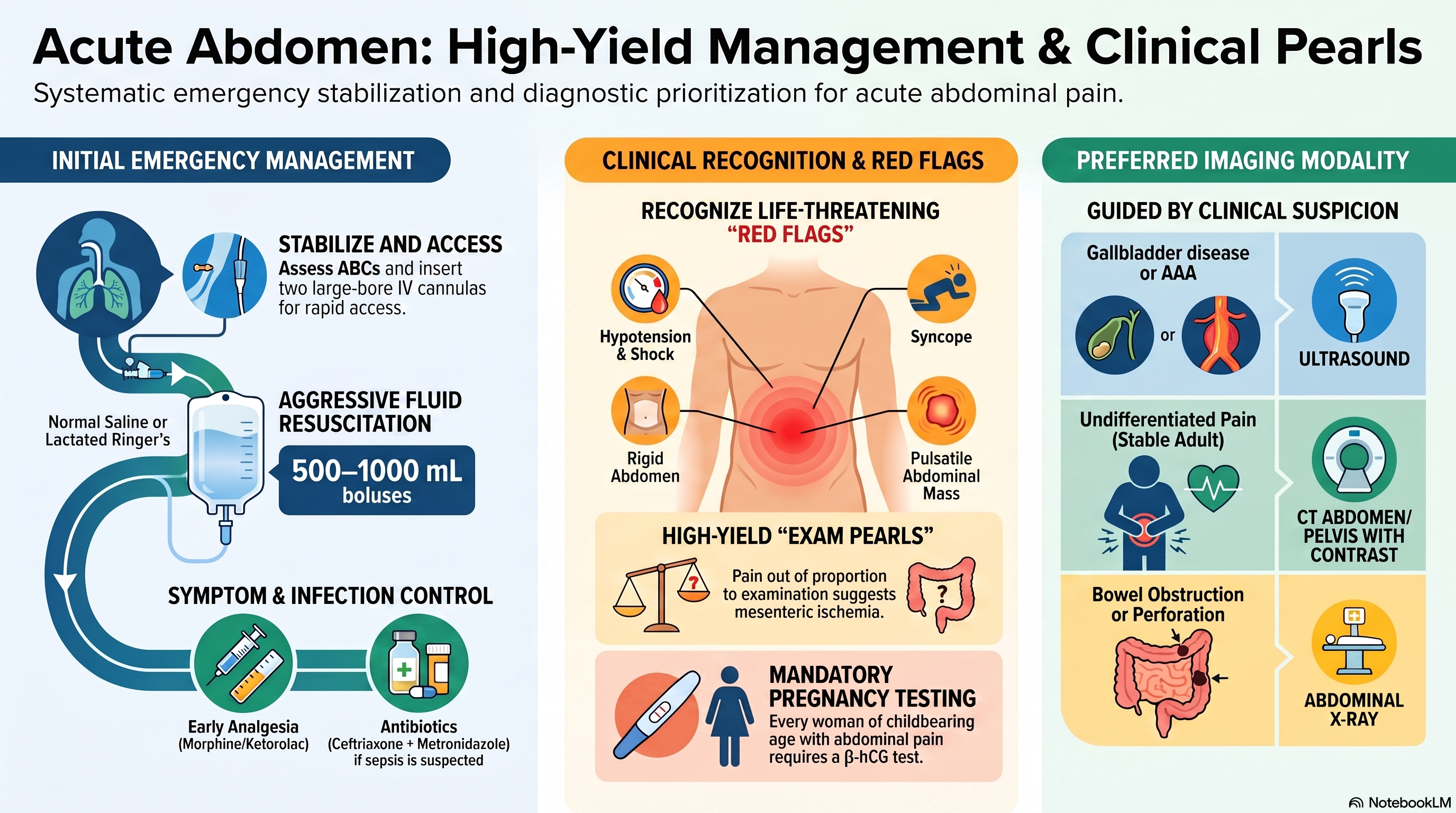
A persistent and dangerous myth in clinical practice is that administering analgesia will "mask" physical findings and lead to diagnostic delay. Evidence and expert consensus now confirm that withholding pain relief is both inhumane and clinically counterproductive. Providing appropriate analgesia often facilitates a more reliable physical examination by reducing patient guarding and allowing for better localization of tenderness.
Early relief through titrated opioids like morphine or hydromorphone is standard of care. While NSAIDs like ketorolac are effective, the prudent clinician must avoid them in patients with suspected gastrointestinal bleeding, renal impairment, or advanced age. Relieving suffering does not obscure peritonitis; it enables the diagnostic process.
"Early analgesia is appropriate and does not mask important clinical findings."
When "Pain Out of Proportion" Signals a Hidden Emergency
In the elderly or those with cardiovascular risk factors, the most terrifying diagnosis is often the one you cannot see on the surface. Mesenteric ischemia typically presents with agonizing, poorly localized pain, yet the physical examination often reveals a soft, non-tender abdomen. This "pain out of proportion to examination" is a classic hallmark of bowel-threatening vascular compromise.
We must teach trainees to identify the embolic source: a history of Atrial Fibrillation is a major red flag for this condition. When an older patient with an irregular pulse presents with severe abdominal pain but a relatively normal exam, the clinician must act immediately. Failure to recognize this mismatch often leads to bowel necrosis, sepsis, and multi-organ failure.
"Pain out of proportion to examination suggests mesenteric ischemia."
The Universal Pregnancy Test Rule
In any patient of childbearing age, the β-hCG test is a non-negotiable safety requirement that transcends the patient's stated sexual or menstrual history. Ectopic pregnancy remains a leading cause of maternal mortality and can present with sudden abdominal pain or, more ominously, unexplained syncope. Syncope in the context of abdominal pain should always be treated as a ruptured ectopic pregnancy or internal hemorrhage until proven otherwise.
Failing to order this simple laboratory test is one of the most common and avoidable pitfalls in emergency care. We must reinforce that a pregnancy test is not just a diagnostic tool, but a life-saving screening intervention. No woman should leave the diagnostic area without this critical data point being addressed.
The Fallacy of "Normal" Laboratory Results
Relying too heavily on a "normal" white blood cell count or C-reactive protein level is a common diagnostic trap. These markers lack the sensitivity to exclude significant surgical pathology, particularly in the early stages of infection or in immunocompromised and elderly populations. Clinical intuition and the physical exam must always take precedence over "clean" bloodwork.
This is especially true for acute appendicitis, where the diagnosis is fundamentally clinical and often supported by imaging rather than inflammatory markers. A normal lab panel provides a false sense of security that can lead to delayed intervention and perforation. Always treat the patient, not the laboratory results.
"Normal laboratory results do not exclude appendicitis."
The Silent Danger in the Elderly
In older patients, the clinical triad of abdominal pain, a pulsatile mass, and hypotension is a ruptured Abdominal Aortic Aneurysm (AAA) until proven otherwise. This is a "no-fail" diagnosis where every second counts toward survival. Diagnostic pathways must be tailored to the patient's hemodynamic status to ensure safety.
For stable adults with undifferentiated pain, CT imaging of the abdomen and pelvis with contrast is the gold standard for identifying hidden emergencies. However, for the unstable patient with suspected AAA, the clinician should bypass the CT suite in favor of bedside ultrasound or immediate surgical consultation. Recognizing this distinction is the difference between a controlled intervention and a terminal event.
Conclusion: The Systematic Safety Net
Navigating the acute abdomen requires a disciplined, step-by-step management protocol to catch what intuition might miss. This begins with a rapid ABC assessment and the placement of two large-bore IVs for fluid resuscitation. For any patient who may require the operating room, maintaining NPO (nothing by mouth) status and considering a nasogastric tube for bowel obstruction are essential steps.
When infection is suspected, the "Safety Net" includes the early administration of broad-spectrum antibiotics, such as Ceftriaxone and Metronidazole, or Piperacillin-Tazobactam. By anchoring our practice in these systematic protocols—Assess, Stabilize, and Investigate—we provide a margin of safety for our most vulnerable patients. The ultimate question for any clinician remains: are you following a system, or are you waiting for the "classic" presentation that may never arrive?