Case 02
Atrial Fibrillation
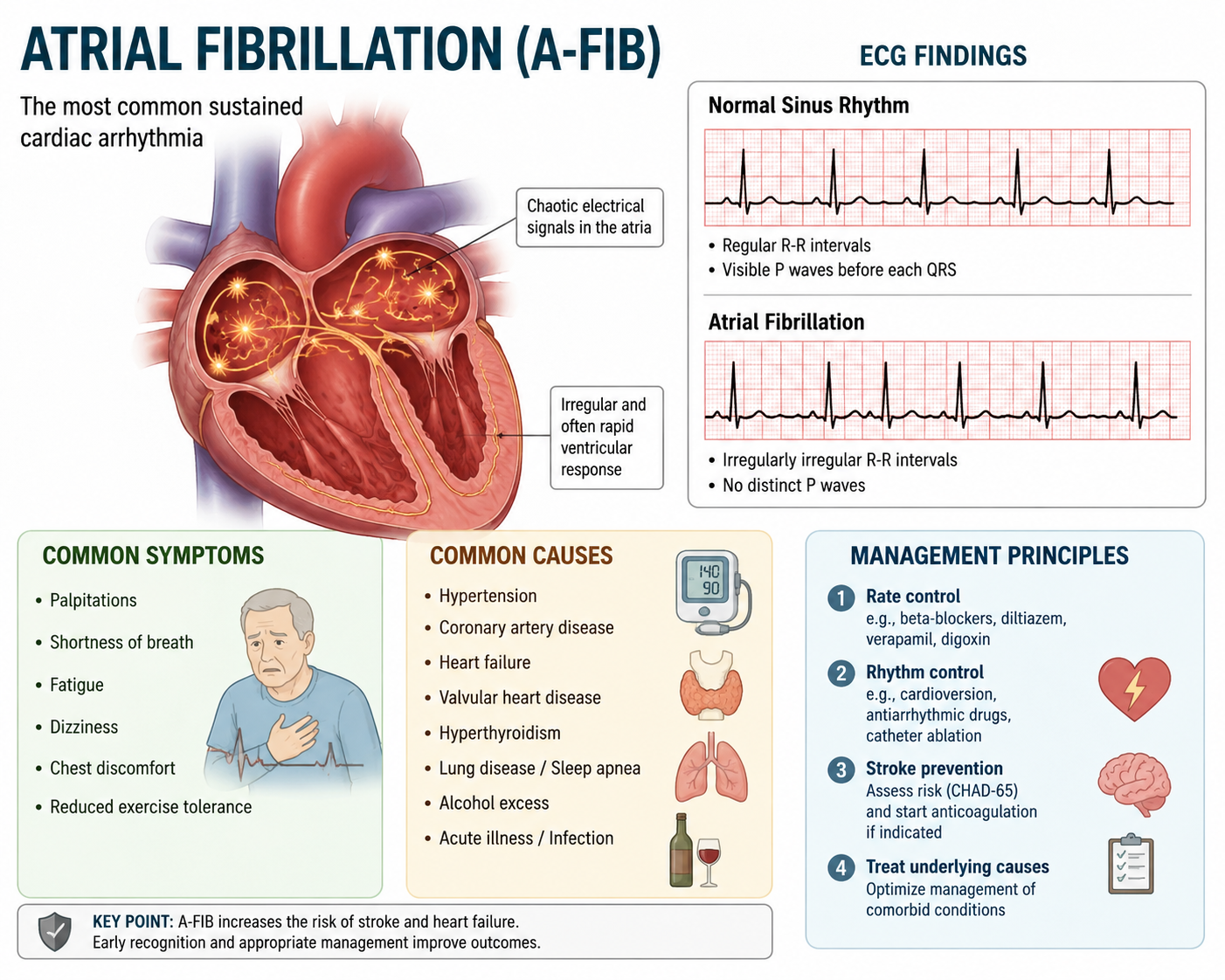
ATRIAL FIBRILLATION (AF): A HIGH-YIELD REVIEW FOR MEDICAL LICENSING EXAMS
Introduction
Welcome to today's episode. Atrial fibrillation (AF) is the most common sustained cardiac arrhythmia encountered in clinical practice. It is a frequent presentation in family medicine, emergency medicine, internal medicine, and cardiology, making it one of the highest-yield topics for Canadian medical licensing examinations including TDM, CCFP, and MCCQE1.
Definition
Atrial fibrillation (AF) is a supraventricular tachyarrhythmia characterized by chaotic atrial electrical activity resulting in:
- Absence of organized P waves
- Irregularly irregular ventricular rhythm
- Loss of effective atrial contraction
- Increased risk of thromboembolism and stroke
Causes
Cardiac Causes
- Hypertension (most common)
- Coronary artery disease
- Heart failure
- Valvular heart disease
- Cardiomyopathy
- Myocarditis
- Congenital heart disease
Non-Cardiac Causes
- Hyperthyroidism
- Pulmonary embolism
- Pneumonia
- Sepsis
- Chronic lung disease
- Obstructive sleep apnea
- Chronic kidney disease
Reversible Causes
- Alcohol ("Holiday Heart")
- Excess caffeine or stimulants
- Electrolyte abnormalities
- Recent surgery
- Acute infection
- Uncontrolled hypertension
Risk Factors
- Age ≥65 years
- Hypertension
- Diabetes mellitus
- Heart failure
- Coronary artery disease
- Obesity
- Sleep apnea
- Chronic kidney disease
- Smoking
- Excess alcohol
- Family history
Clinical Presentation
Many patients are asymptomatic.
Common symptoms include:
- Palpitations
- Rapid heartbeat
- Shortness of breath
- Fatigue
- Reduced exercise tolerance
- Chest discomfort
- Dizziness
- Syncope
- Stroke symptoms
SOAP Approach
Subjective
Ask about:
- Onset and duration
- Palpitations
- Chest pain
- Dyspnea
- Dizziness
- Syncope
- Previous AF episodes
- Medication history
- Alcohol use
- Thyroid disease
- Recent illness
- Stroke or TIA history
- Bleeding history
Objective
Vital Signs
- Heart rate
- Blood pressure
- Oxygen saturation
- Temperature
Physical Examination
Cardiovascular
- Irregularly irregular pulse
- Tachycardia
- Murmurs
- Signs of heart failure
Respiratory
- Pulmonary edema
- Infection
Neurological
- Evidence of stroke
Investigations
Essential
- 12-lead ECG
- CBC
- Electrolytes
- Creatinine/eGFR
- TSH
- Glucose or HbA1c
Additional
- Troponin if ischemia suspected
- BNP if heart failure suspected
- Chest X-ray
- Echocardiogram
- Holter monitor if intermittent symptoms
ECG Findings
- No distinct P waves
- Irregularly irregular rhythm
- Variable R-R intervals
Assessment
Determine:
- Stable or unstable patient?
- New-onset or recurrent AF?
- Paroxysmal, persistent, or permanent AF?
- Reversible cause present?
- Need for anticoagulation using the Canadian CHAD-65 approach.
Management (Canadian Guidelines)
Step 1: Is the Patient Stable?
Unstable Features
- Hypotension
- Shock
- Acute pulmonary edema
- Ongoing ischemic chest pain
- Altered mental status
- Syncope
Management
Immediate referral to the Emergency Department for synchronized electrical cardioversion.
Step 2: Rate Control
Rate control is appropriate for most stable patients.
Metoprolol
- Start 25–50 mg orally twice daily
- Titrate gradually
- Typical maintenance: 50–100 mg twice daily
Bisoprolol
- 2.5–5 mg orally once daily
- Maximum: 10 mg daily
Diltiazem (avoid in HFrEF)
- Extended-release 120–180 mg once daily
- Maximum: 360 mg daily
Verapamil
- Extended-release 120–180 mg once daily
- Maximum: 480 mg daily
Digoxin
Useful mainly in:
- Heart failure
- Sedentary patients
Typical maintenance:
- 0.125 mg daily
- Lower doses in elderly patients and renal impairment
Step 3: Stroke Prevention (CHAD-65)
The Canadian CHAD-65 approach recommends anticoagulation if:
Age ≥65 years
OR
Any one of:
- Congestive heart failure
- Hypertension
- Diabetes mellitus
- Previous stroke or TIA
If CHAD-65 positive:
Start anticoagulation unless contraindicated.
Preferred DOACs:
Apixaban
- 5 mg twice daily
- Reduce to 2.5 mg twice daily in eligible patients
Rivaroxaban
- 20 mg once daily with food
- 15 mg once daily if renal function is reduced
Dabigatran
- 150 mg twice daily
- Lower dose may be appropriate in selected patients
Edoxaban
- 60 mg once daily
- Dose reduction when indicated
Warfarin
Indications:
- Mechanical heart valves
- Moderate or severe rheumatic mitral stenosis
Target INR:
2.0–3.0
Step 4: Rhythm Control
Consider rhythm control if:
- Significant symptoms
- Younger patients
- First episode
- Heart failure related to AF
- Patient preference
- Failure of rate control
Options:
- Electrical cardioversion
- Antiarrhythmic drugs
- Catheter ablation
Lifestyle Management
- Stop smoking
- Reduce alcohol intake
- Weight reduction
- Regular exercise
- Control blood pressure
- Manage diabetes
- Treat sleep apnea
Follow-Up in Family Medicine
Review within 1–4 weeks:
- Symptoms
- Heart rate
- Blood pressure
- Medication tolerance
- Renal function if taking a DOAC
Arrange:
- Echocardiogram if not already performed
- Cardiology referral if persistent symptoms, recurrent AF, uncertainty about rhythm control, or consideration of catheter ablation
Complications
- Ischemic stroke
- Systemic embolism
- Heart failure
- Tachycardia-induced cardiomyopathy
- Reduced quality of life
Red Flags
Urgent referral if:
- Hypotension
- Acute pulmonary edema
- Chest pain suggestive of myocardial infarction
- Syncope
- Acute stroke symptoms
- Altered mental status
Exam Pearls
- Always assess whether the patient is stable first.
- Confirm AF with a 12-lead ECG.
- Search for reversible causes such as hyperthyroidism, infection, and alcohol use.
- Use the Canadian CHAD-65 approach to determine the need for anticoagulation.
- DOACs are preferred for most patients with non-valvular AF.
- Immediate synchronized cardioversion is indicated for unstable patients.
Take-Home Message
Think systematically:
Recognize AF → Assess stability → Investigate reversible causes → Control the rate or rhythm → Apply CHAD-65 for stroke prevention → Arrange appropriate follow-up and referral when needed.
This content is for educational purposes only and does not constitute medical advice or clinical guidance. Read the full disclaimer.