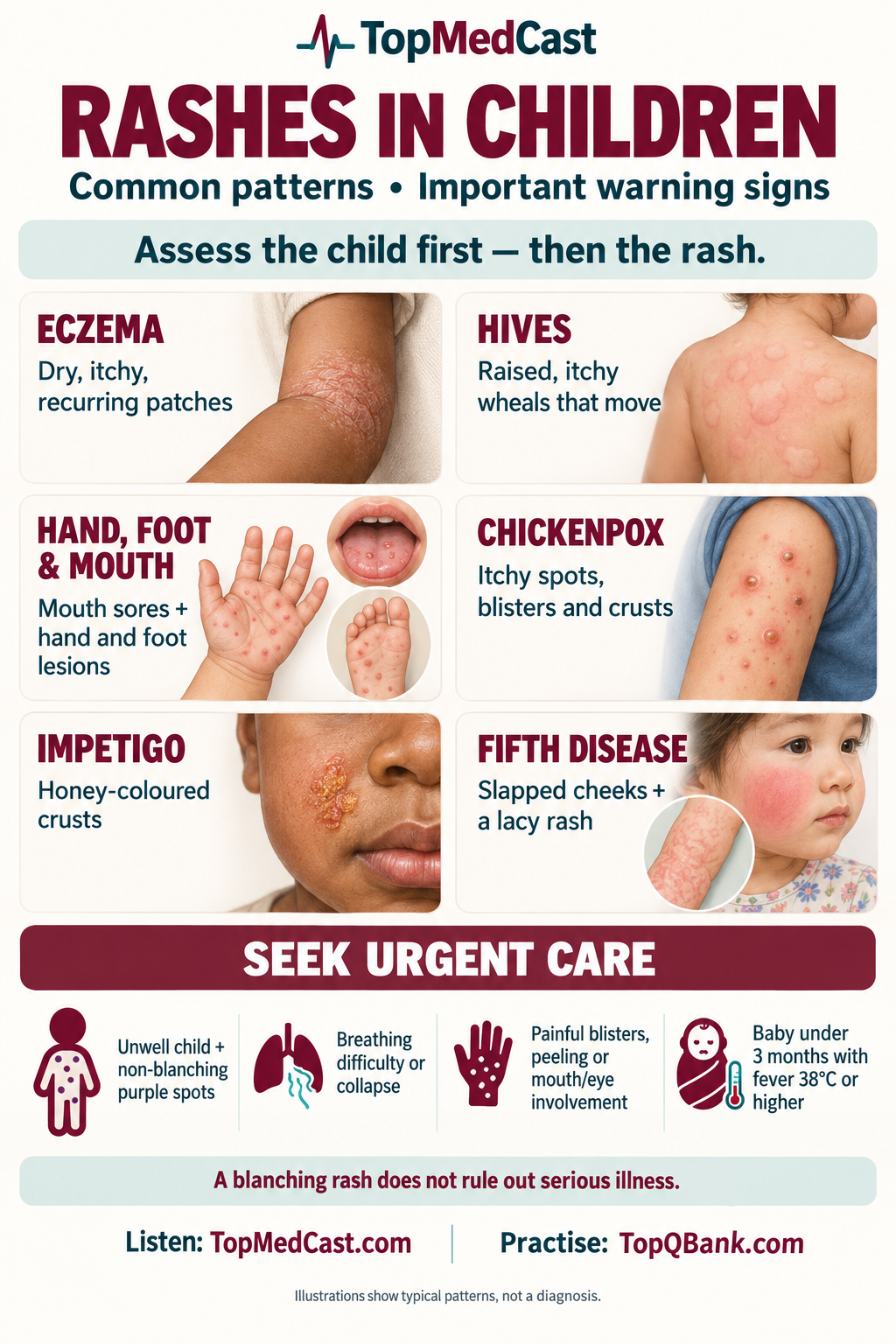
Rashes in Children
A Practical Approach to Diagnosis, Red Flags and Management
Introduction
Welcome to TopMedCast. A parent brings their child to the clinic and says, “This rash appeared yesterday. Should I be worried?”
The answer depends on more than the appearance of the skin. The child’s age, general condition, associated symptoms and the progression of the rash all matter.
Today, we will follow a structured approach: assess safety, take a focused history, examine the child, recognise warning signs, investigate selectively and choose appropriate treatment.
1. Initial Assessment
Is the Child Well or Unwell?
Before naming the rash, look at the child.
Are they alert and interacting normally? Are they breathing comfortably? Are they drinking and passing urine? Do they look pale, mottled, unusually sleepy or distressed?
Check temperature, heart rate, respiratory rate, oxygen saturation and circulation when indicated. Assess hydration and use age-appropriate observations.
A rash in a playful child is a different presentation from a rash in a child with poor perfusion, altered consciousness or respiratory distress.
An infant younger than three months with a temperature of 38 degrees Celsius or higher needs urgent assessment for serious infection. Do not assume that a rash explains the fever.
2. History
Establish the Sequence
Ask when the rash started, where it first appeared and how it spread.
Did fever come before the rash, begin at the same time or settle as the rash appeared? Is the rash itchy, painful or neither?
Ask whether individual lesions disappear and reappear elsewhere, remain fixed, blister, crust or peel.
Then explore associated symptoms:
- Fever, cough, runny nose or red eyes.
- Sore throat or mouth ulcers.
- Breathing difficulty or swelling.
- Vomiting, diarrhoea or abdominal pain.
- Joint pain, limping or swelling.
- Bruising, bleeding or changes in urine.
- Poor feeding, reduced urine output or unusual behaviour.
Review new medicines, recent infections, vaccination history, travel, sick contacts and exposure to new skin products.
If the rash is itchy, ask whether anyone else at home is scratching, particularly at night.
Ask about eczema, allergies, immunosuppression and previous episodes. Clarify what treatments the family has already tried.
3. Examination
Describe Before You Diagnose
Examine the whole child, with appropriate consent and privacy.
Look at the distribution: face, trunk, limbs, skin folds, diaper area, palms, soles and scalp. Examine the mouth and eyes when relevant.
Describe the lesions in plain terms: flat spots, raised bumps, wheals, blisters, pustules, crusting, scaling or purple spots.
Assess whether the rash blanches with pressure. Petechiae and purpura do not blanch.
However, blanching alone does not establish safety. Serious illness can precede a non-blanching rash, and an early rash may change.
On darker skin, redness may be less obvious. Pay attention to texture, warmth, swelling, tenderness and changes from the child’s usual skin colour.
Look beyond the skin for dehydration, lymphadenopathy, joint swelling and abdominal findings.
4. Red Flags
Findings That Change the Plan
An Unwell Child With Petechiae or Purpura
A non-blanching rash with fever or systemic illness requires urgent assessment. Rapidly spreading purpura, poor circulation, lethargy or altered consciousness raises concern for invasive infection.
Arrange emergency transfer when the child is unwell. Do not delay emergency treatment to complete routine outpatient investigations.
Not every petechial rash is meningococcal disease. Localised petechiae may follow coughing or vomiting, and other causes include platelet disorders and vasculitis. The clinical context determines the investigation and disposition.
Rash With Breathing Difficulty or Collapse
Hives accompanied by airway swelling, breathing difficulty or cardiovascular compromise may represent anaphylaxis.
Give intramuscular epinephrine promptly according to the child’s weight and the local emergency protocol, and activate emergency services.
Antihistamines do not replace epinephrine. Anaphylaxis can also occur without a visible rash.
Painful Blistering, Peeling or Mucosal Erosions
Painful skin, widespread blistering or peeling, especially with mouth, eye or genital involvement, needs emergency assessment.
Consider a severe drug reaction such as Stevens–Johnson syndrome. Review recent medicines and stop the suspected culprit while arranging urgent care.
Eczema With Painful Erosions
A child with eczema who develops rapidly spreading painful blisters or punched-out erosions may have eczema herpeticum.
Arrange urgent same-day assessment and antiviral treatment. Fever, systemic illness or eye involvement increases the urgency. Do not treat this as an ordinary eczema flare alone.
Persistent Fever and Inflammatory Features
Think about Kawasaki disease when fever persists with rash, bilateral non-purulent conjunctivitis, red or cracked lips, oral changes, swollen hands or feet, or cervical lymphadenopathy.
The features may appear at different times. Incomplete presentations occur, particularly in infants.
Seek urgent paediatric assessment. Do not wait for every feature or a fixed number of fever days when suspicion is strong.
5. Investigations
Test to Answer a Clinical Question
A well child with a typical uncomplicated viral rash often needs no laboratory testing.
Investigations become appropriate when the child is unwell, the diagnosis is uncertain or systemic involvement is suspected.
Examples include:
- Blood count and other targeted tests for unexplained petechiae, purpura or bleeding.
- Urinalysis and blood pressure measurement for suspected IgA vasculitis.
- Throat testing for suspected scarlet fever.
- Skin swabs for selected severe, recurrent or treatment-resistant infections.
- Fungal testing when the diagnosis is uncertain.
- Public health-directed testing for suspected measles.
Avoid broad allergy testing for every rash. Many childhood rashes and episodes of urticaria are infection-related.
6. Common Rash Patterns
Recognising the Likely Diagnosis
Viral Exanthem
A widespread rash accompanying a mild viral illness is common. The child’s general condition should guide management.
Provide fluids, comfort measures and follow-up advice. “Viral rash” should remain a working diagnosis that is reconsidered if the child deteriorates.
Roseola
Roseola commonly causes several days of fever in a young child, followed by a rash as the fever settles.
The sequence is helpful, but assess the child during the febrile phase rather than assuming that a future rash will confirm a benign illness.
Fifth Disease
Parvovirus B19 may cause a slapped-cheek appearance followed by a lacy rash on the body.
Most otherwise healthy children need supportive care. Infection can have greater significance in children with certain blood disorders or immunosuppression.
A pregnant person with relevant exposure should contact their healthcare provider.
Hand, Foot and Mouth Disease
Mouth sores with lesions on the hands, feet and sometimes buttocks suggest hand, foot and mouth disease.
Management is usually supportive. Painful mouth ulcers can reduce drinking, so hydration is a central concern.
Chickenpox
Chickenpox typically produces itchy lesions in crops, with spots, blisters and crusts present at different stages. Vaccinated children may have less typical disease.
Most healthy young children need supportive care. Severe illness or a high-risk child requires assessment for antiviral treatment.
Avoid aspirin. Ibuprofen is also generally avoided in chickenpox where possible.
Measles
Fever with cough, coryza, conjunctivitis and a spreading rash should raise suspicion, particularly with incomplete vaccination or a relevant exposure.
Do not leave a suspected case in a shared waiting room. Arrange airborne precautions and contact public health promptly for testing and further advice.
Scarlet Fever
Fever, sore throat and a fine sandpaper-like rash suggest scarlet fever. A strawberry tongue and accentuation in skin folds may occur.
Confirm group A streptococcal infection with appropriate testing. Treat confirmed infection with antibiotics according to local guidance.
Atopic Eczema
Eczema causes dry, itchy, recurrent inflammation. Distribution changes with age: infants often have facial involvement, while older children commonly have flexural disease.
Use regular emollients and an appropriate topical corticosteroid for active inflammation. Match potency and duration to age, body site and severity.
Explain how to apply treatment and address concerns about steroids. Avoid unnecessary food restriction or allergy testing without a supporting history.
Urticaria
Urticaria produces itchy, raised wheals that move around. Individual wheals usually resolve within 24 hours.
Viral illness is a common trigger in children. A reproducible reaction shortly after a particular exposure makes allergy more likely.
Use an age-appropriate non-sedating antihistamine for uncomplicated symptoms. Fixed, painful or bruising lesions need reassessment.
Impetigo
Honey-coloured crusts, often around the nose and mouth, suggest impetigo.
Localised disease may be treated with a short topical antibiotic course. Widespread, bullous or systemic disease may require oral treatment. Follow local resistance guidance.
Scabies
Think about scabies when itching is intense at night and other household members are affected.
Infants may have scalp, palm and sole involvement.
Treatment must include close contacts at the same time. Give clear instructions about application, repeat treatment and managing bedding and clothing.
Fungal Infection
A scaly ring-shaped lesion may represent tinea corporis. Scalp scaling with broken hairs or patchy hair loss suggests tinea capitis.
Localised skin infection often responds to topical antifungals. Scalp infection requires systemic treatment; creams alone are inadequate.
Diaper Dermatitis
Irritant diaper dermatitis usually affects exposed surfaces and often spares the folds.
Frequent changes, gentle cleaning and a barrier preparation help.
Candida is more likely when folds are involved and satellite spots or pustules are present. Add an appropriate topical antifungal when indicated.
IgA Vasculitis
Palpable purpura over the legs and buttocks, with joint or abdominal symptoms, suggests IgA vasculitis.
Check blood pressure and urine at presentation and during follow-up because renal involvement can be silent.
Severe abdominal pain, gastrointestinal bleeding, significant renal findings or testicular pain requires urgent assessment.
7. Management and Parent Counselling
Give a Clear, Practical Plan
Explain the likely diagnosis, expected course and treatment.
Tell parents exactly how to use creams or medicines. Use weight-based prescribing and check age restrictions.
Discuss hydration, comfort, scratching, hand hygiene and whether school or childcare attendance needs adjustment.
Exclusion advice depends on the diagnosis and local public health guidance.
Ask the parent to describe the plan back to you. This helps identify uncertainty before they leave.
8. Referral and Follow-Up
Make Return Advice Specific
Arrange follow-up when the diagnosis is uncertain, symptoms persist or treatment is ineffective.
Seek specialist advice for severe eczema, recurrent significant infections, suspected systemic disease or a persistent unexplained rash.
Tell parents to seek emergency care for breathing difficulty, collapse, marked drowsiness, rapidly spreading purple lesions, or painful blistering with eye or mouth involvement.
Arrange prompt reassessment for poor drinking, reduced urine output, persistent fever, worsening pain or a child who is becoming less well.
Closing
The safest approach to a childhood rash begins with the child, then the skin.
Assess general condition, establish the sequence, examine the rash carefully, recognise warning signs and give the family a clear plan.
This is TopMedCast. Thank you for listening to Rashes in Children: A Practical Approach to Diagnosis, Red Flags and Management.
This content is for educational purposes only and does not constitute medical advice or clinical guidance. Read the full disclaimer.