Show notes & transcript
Thyroid Mysteries: Six Patients, Six Different Stories
A tired patient. A racing heart. A painful neck. A new mother who feels unlike herself. Thyroid disease can appear in many different ways. These six fictional cases explore how to follow the clues, interpret the results and choose the next step.
Case 1: “I Thought I Was Just Getting Older”
A 46-year-old woman presents with six months of fatigue, constipation and difficulty concentrating. She has gained five kilograms and feels cold when everyone else is comfortable. Her periods have become heavier.
Her pulse is 56 beats per minute. Her skin is dry, and examination reveals a mildly enlarged, painless thyroid.
Blood tests show a TSH of 24 mIU/L and a free T4 below the laboratory reference range. Thyroid peroxidase antibodies are positive.
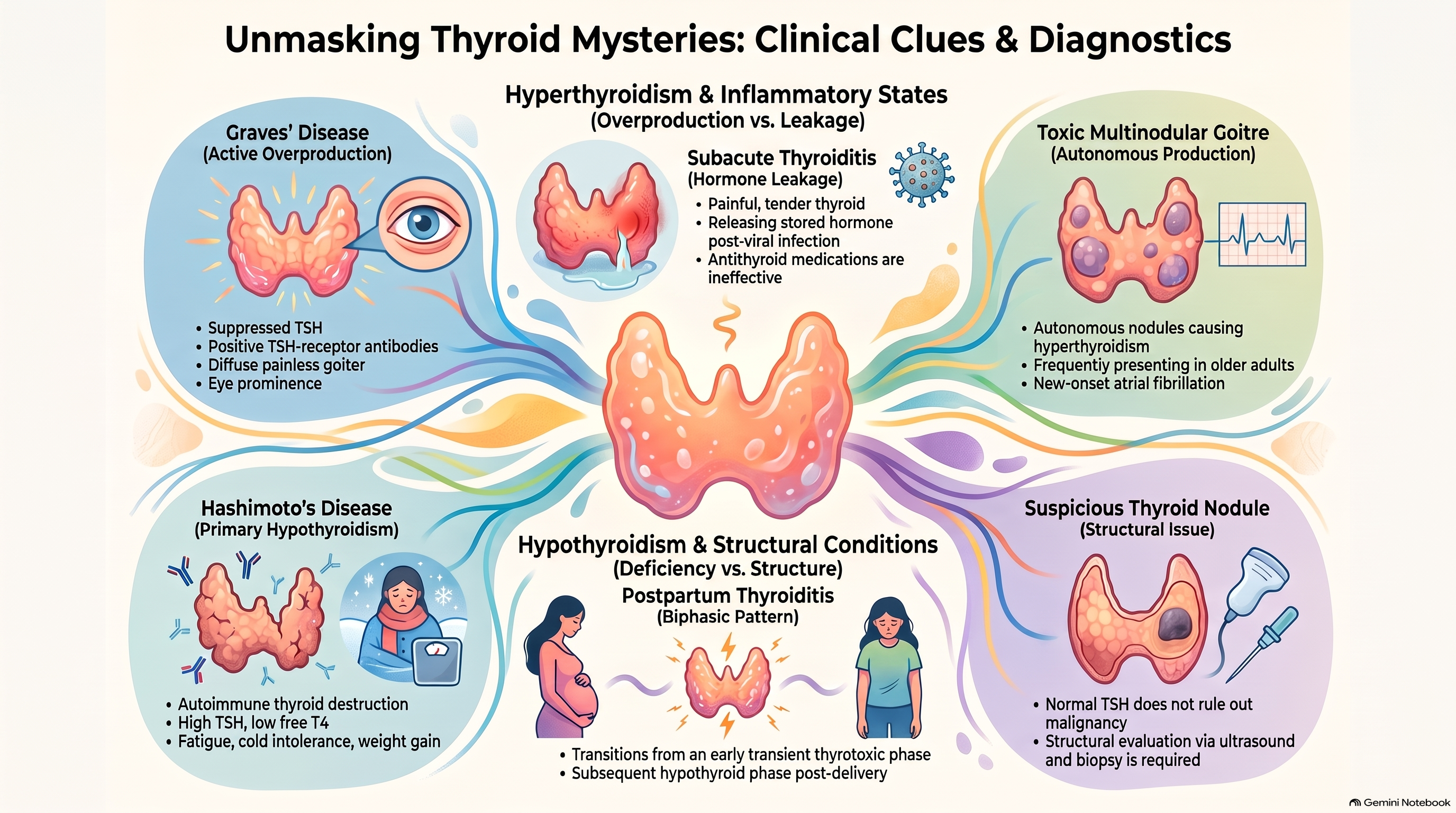
The reveal: Hashimoto’s disease causing overt primary hypothyroidism.
The elevated TSH shows that the pituitary is asking the thyroid to work harder. The low free T4 confirms that the thyroid is failing to produce enough hormone. Positive antibodies support an autoimmune cause.
Treatment is levothyroxine, with the starting dose tailored to weight, age and cardiac history. Older patients and those with coronary disease generally need a cautious starting dose. Review administration and interactions, including iron and calcium, and repeat TSH approximately six to eight weeks after starting treatment or changing the dose.
Take-home message: A cluster of fatigue, cold intolerance, constipation and weight gain deserves investigation rather than being attributed to ageing alone. thyroid.org
Case 2: “Everyone Says It Is Anxiety”
A 32-year-old woman describes palpitations, sweating and poor sleep. She has lost six kilograms despite eating more. She feels anxious but says the physical symptoms started before the worry.
Her pulse is 116 beats per minute. She has a fine tremor, a diffuse painless goitre and mild eye prominence.
TSH is suppressed, free T4 and free T3 are elevated, and TSH-receptor antibodies are positive.
The reveal: Graves’ disease.
The antibody result and diffuse thyroid enlargement support autoimmune hyperthyroidism. Eye findings provide another clue.
A beta blocker may relieve palpitations and tremor when appropriate. Methimazole is commonly used in Canadian practice, with baseline blood count and liver tests and subsequent thyroid monitoring. Pregnancy status affects treatment choice.
Explain that fever or a sore throat while taking an antithyroid drug requires stopping the medication and obtaining urgent medical assessment for possible agranulocytosis. Jaundice also requires urgent assessment. Radioactive iodine and surgery are additional options, chosen according to the clinical situation and patient preferences.
Take-home message: Anxiety accompanied by weight loss, persistent tachycardia, tremor and heat intolerance should prompt consideration of hyperthyroidism. NICE
Case 3: “My Neck Hurts Since That Cold”
A 40-year-old man develops anterior neck pain two weeks after a respiratory illness. The pain radiates towards his jaw and worsens when he swallows. He also notices sweating and palpitations.
His thyroid is diffusely tender. His pulse is 104 beats per minute, and he has a low-grade fever.
TSH is suppressed, free T4 is elevated, and inflammatory markers are raised.
The reveal: Subacute painful thyroiditis.
The key distinction is that damaged thyroid cells are releasing stored hormone. The gland is not actively manufacturing excessive amounts.
Treatment focuses on pain and symptoms. An NSAID may help when suitable; severe or persistent pain may require corticosteroids after assessment. A beta blocker can reduce troublesome palpitations.
Antithyroid drugs generally do not help this destructive process. Follow thyroid function because a hypothyroid phase may follow before recovery. High fever, focal swelling or systemic toxicity should trigger urgent assessment for infection or another cause.
Take-home message: A low TSH does not automatically mean the patient needs methimazole. Identify why thyroid hormone is elevated. American Thyroid Association
Case 4: “I Have Not Felt Like Myself Since Giving Birth”
A 29-year-old woman presents eight months after delivery with fatigue, constipation and low mood. She assumes these symptoms reflect sleepless nights.
On further questioning, she recalls several weeks of palpitations and unexplained weight loss three months after delivery. Those symptoms resolved without treatment.
Her thyroid is painless. Current testing shows a TSH of 16 mIU/L, low free T4 and positive thyroid peroxidase antibodies.
The reveal: Postpartum thyroiditis, now in the hypothyroid phase.
An earlier thyrotoxic phase followed by hypothyroidism is a characteristic pattern, although some patients experience only one phase.
Symptomatic overt hypothyroidism warrants levothyroxine. It is compatible with breastfeeding. Follow-up determines whether replacement remains necessary; some patients recover, while others develop permanent hypothyroidism.
During the earlier thyrotoxic phase, a beta blocker may help symptoms, but antithyroid drugs are generally ineffective because hormone is leaking from an inflamed gland.
Assess mood separately, including safety concerns. A thyroid diagnosis does not exclude coexisting postpartum depression.
Take-home message: Postpartum symptoms deserve careful assessment, particularly when the patient describes a change from palpitations and weight loss to fatigue and slowing down. thyroid.org
Case 5: “The Heart Problem Started in the Neck”
A 74-year-old man presents with reduced exercise tolerance and weight loss. He does not describe anxiety or obvious heat intolerance.
His pulse is irregular at 128 beats per minute. ECG confirms atrial fibrillation. Examination reveals a longstanding, irregularly enlarged thyroid.
TSH is suppressed and free T4 is elevated. TSH-receptor antibodies are negative. A radionuclide scan shows several areas of increased uptake.
The reveal: Toxic multinodular goitre.
Multiple nodules are producing hormone independently of normal regulation. In older adults, the presentation may be dominated by cardiac symptoms, weight loss or weakness.
Assess clinical stability and manage the atrial fibrillation, including stroke-risk assessment. Thyroid treatment may include a beta blocker and methimazole to control hormone production.
Specialist discussion addresses longer-term treatment with radioactive iodine or surgery. Large goitres causing swallowing or breathing difficulties particularly warrant surgical assessment.
Take-home message: New atrial fibrillation can be the presenting feature of thyroid disease, even without the classic energetic, tremulous appearance. American Thyroid Association
Case 6: “The Blood Tests Are Normal—So Is the Lump Safe?”
A 51-year-old woman notices a painless neck lump. She feels well and has no weight change, palpitations or cold intolerance.
Her TSH is normal. Ultrasound identifies a 1.8-centimetre solid hypoechoic thyroid nodule with irregular margins and punctate echogenic foci.
The reveal: A suspicious thyroid nodule requiring further evaluation.
Normal thyroid function does not establish that a nodule is benign. Blood tests assess function; ultrasound evaluates structural features and guides the need for biopsy.
This nodule warrants ultrasound-guided fine-needle aspiration under an established risk-stratification system. Assess cervical lymph nodes and arrange the appropriate specialist pathway. The diagnosis of cancer requires cytological or histological evidence.
Persistent hoarseness, rapid growth, suspicious lymph nodes or compressive symptoms increase concern. Breathing difficulty or stridor requires emergency assessment.
Take-home message: A normal TSH should never end the investigation of a suspicious thyroid lump. American Thyroid Association
Closing
Six patients, six different stories—and one essential habit: interpret thyroid results alongside the clinical picture. Ask whether the problem is hormone deficiency, excess production, hormone leakage or a structural abnormality.
Continue learning with TopMedCast.com, and practise your clinical reasoning at TopQBank.com.
This content is for educational purposes only and does not constitute medical advice or clinical guidance. Read the full disclaimer.