Show notes & transcript
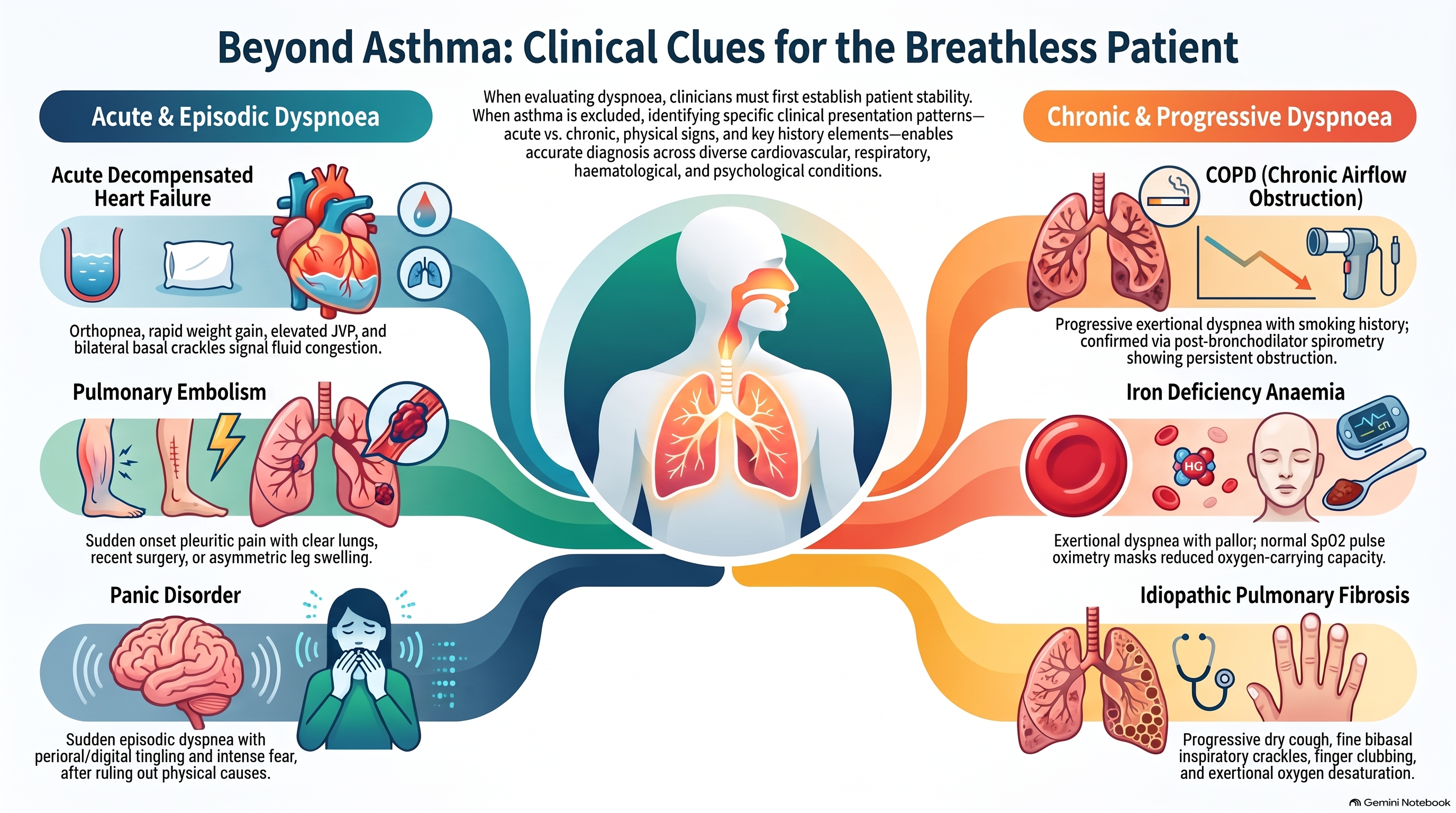
The Breathless Patient: Six Cases Beyond Asthma
Opening
“I can’t catch my breath.”
Six patients say the same words, but each has a different story. One cannot lie flat. Another becomes breathless suddenly after surgery. A third has clear lungs and a normal oxygen saturation, yet struggles to climb the stairs.
Welcome to TopMedCast. Today, we follow six fictional patients through the clues, investigations and decisions that reveal what is causing their breathlessness.
Before the First Case: Is the Patient Stable?
Before searching for a diagnosis, assess airway, breathing, circulation, mental status and vital signs.
Severe respiratory distress, inability to speak in full sentences, cyanosis, confusion, syncope, hypotension or significant chest pain requires emergency assessment. A normal oxygen saturation alone does not establish that a patient is safe.
Case 1: “I Have Started Sleeping in My Chair”
A 72-year-old man visits the clinic because walking from his bedroom to the kitchen leaves him breathless.
At first, he blames his age. Then he mentions that he has stopped sleeping in bed.
“When I lie down, I feel like I’m suffocating. Sitting up helps.”
Over the past week, his shoes have become tight and his weight has increased by three kilograms. He has hypertension and a previous myocardial infarction.
His respiratory rate is 26, pulse 104 and oxygen saturation 90% on room air. Examination reveals elevated jugular venous pressure, bilateral basal crackles and pitting ankle oedema.
Follow the Clues
Breathlessness when lying flat, rapid weight gain and peripheral oedema suggest fluid congestion. The combination of lung crackles and elevated jugular venous pressure points towards a cardiac cause.
He needs urgent hospital assessment. ECG, chest X-ray, blood count, renal function, electrolytes and natriuretic peptide testing help assess the presentation. Echocardiography evaluates cardiac structure and function.
The chest X-ray shows pulmonary congestion. Echocardiography subsequently identifies an ejection fraction of 30%.
The Diagnosis: Acute Decompensated Heart Failure
His immediate treatment addresses hypoxaemia and congestion, including oxygen when indicated and intravenous loop diuretics with monitoring of renal function, electrolytes and urine output. The team also searches for a trigger, such as ischaemia, infection, arrhythmia or medication problems. NICE
After stabilisation, treatment for heart failure with reduced ejection fraction generally includes four foundational drug classes: an ARNI—or an ACE inhibitor or ARB when appropriate—a proven beta blocker, a mineralocorticoid receptor antagonist and an SGLT2 inhibitor. Introduction and adjustment depend on blood pressure, kidney function, potassium and clinical stability. Canadian Cardiovascular Society
Take-Home Message
Ask every breathless patient whether they can lie flat. A change in sleeping position can reveal a problem that the patient has dismissed as ageing.
Case 2: “It Started Suddenly This Morning”
A 48-year-old woman develops sudden breathlessness and sharp right-sided chest pain that worsens with inspiration.
She underwent knee replacement twelve days ago and has been less mobile. She also notices that her left calf feels swollen.
Her pulse is 118, respiratory rate 28 and oxygen saturation 91% on room air. Blood pressure is 112/72. Her lungs sound relatively clear.
Follow the Clues
Recent surgery, immobility, unilateral calf swelling and sudden pleuritic pain create a strong suspicion of pulmonary embolism.
Clear lungs do not exclude it.
She is transferred urgently for assessment. Clinical probability guides testing. D-dimer is useful in selected patients with a low or unlikely probability; it should not delay imaging when pulmonary embolism is likely.
CT pulmonary angiography demonstrates a pulmonary embolus.
The Diagnosis: Pulmonary Embolism
Treatment includes anticoagulation when appropriate, with the choice influenced by bleeding risk, renal function, pregnancy, cancer and other clinical factors.
Confirmed pulmonary embolism requires risk stratification. Selected low-risk patients can receive outpatient treatment, but this patient’s hypoxaemia and tachycardia require careful hospital assessment. Shock or persistent hypotension demands an urgent specialist pathway for possible reperfusion treatment. nice.org.uk
Take-Home Message
Sudden breathlessness with relatively clear lungs should raise concern. Always ask about recent surgery, immobility, previous clots and leg symptoms.
Case 3: “My Inhaler Helps, but I Still Cannot Keep Up”
A 65-year-old man reports gradually worsening breathlessness over three years.
He now stops halfway up a flight of stairs. He coughs most mornings and produces a small amount of sputum. He has a 40-pack-year smoking history.
He has occasionally used a salbutamol inhaler but has never undergone spirometry.
His oxygen saturation is 94% at rest. Examination reveals reduced air entry, prolonged expiration and scattered wheeze.
Follow the Clues
The history suggests chronic airflow obstruction, but smoking and wheeze alone do not confirm COPD.
Post-bronchodilator spirometry shows an FEV1/FVC ratio of 0.56, confirming persistent obstruction in this clinical context.
The Diagnosis: COPD
Management includes smoking cessation support, vaccination, physical activity, pulmonary rehabilitation and appropriate inhaled bronchodilators. Check inhaler technique before assuming treatment failure.
Inhaled corticosteroids are reserved for selected patients, considering exacerbation history, blood eosinophils and coexisting asthma. They are not automatically required for every patient with COPD.
Long-term oxygen requires formal assessment for qualifying persistent hypoxaemia; breathlessness alone is not an indication. NICE
The Twist
Several months later, he develops abruptly worse breathlessness and pleuritic pain. His established COPD diagnosis must not end the assessment: pulmonary embolism, pneumonia, pneumothorax and cardiac disease remain possible.
Take-Home Message
Confirm COPD with spirometry, and investigate a new pattern of breathlessness even when the patient already has a respiratory diagnosis.
Case 4: “My Oxygen Is Normal—Why Am I So Breathless?”
A 58-year-old woman becomes breathless when walking uphill. She feels exhausted and notices her heart racing with exertion.
She has no cough, wheeze or orthopnoea. Her oxygen saturation is 98%, and her lungs are clear.
She appears pale. Her pulse is 102.
Blood tests show haemoglobin of 82 g/L, an MCV of 69 fL and ferritin of 6 micrograms/L.
Follow the Clues
The microcytosis and very low ferritin indicate iron deficiency anaemia.
The pulse oximeter measures the proportion of haemoglobin carrying oxygen. It does not measure how much haemoglobin is available. A normal reading can therefore coexist with reduced oxygen-carrying capacity.
The Diagnosis: Iron Deficiency Anaemia
Treat the deficiency while investigating its cause. Oral iron is often suitable; intravenous iron may be needed when oral therapy is ineffective, poorly tolerated or unsuitable.
She is postmenopausal, so unexplained iron deficiency warrants gastrointestinal investigation rather than being attributed to diet alone. Consider blood loss, malabsorption and coeliac disease, and monitor the response to replacement. bsg.org.uk
The Patient’s Question
“Once my blood count improves, does that mean everything is solved?”
Improvement confirms that treatment is helping. It does not explain why the iron deficiency developed.
Take-Home Message
Clear lungs and normal oxygen saturation do not exclude a significant cause of breathlessness. Remember the blood count—and investigate the reason behind the anaemia.
Case 5: “The Cough Is Dry, but the Breathlessness Keeps Getting Worse”
A 69-year-old man presents with a persistent dry cough and progressive breathlessness over ten months.
He used to walk several kilometres. Now he stops after a few hundred metres.
He has no ankle swelling or orthopnoea. Examination reveals fine bibasal inspiratory crackles and finger clubbing. His oxygen saturation falls during supervised walking.
Follow the Clues
Progressive breathlessness, dry cough, fine crackles and exertional desaturation suggest interstitial lung disease.
The history must explore occupational exposures, birds, mould, medications and symptoms of connective tissue disease.
Pulmonary function testing shows restriction and reduced gas transfer. High-resolution CT demonstrates a fibrotic pattern. Specialist multidisciplinary review finds no identifiable underlying cause and confirms idiopathic pulmonary fibrosis.
The Diagnosis: Idiopathic Pulmonary Fibrosis
Referral to an interstitial lung disease service is essential. Management may include antifibrotic treatment, pulmonary rehabilitation, oxygen assessment, vaccination and symptom support, with transplant assessment where appropriate.
Treatment depends on the exact disease. Fibrotic interstitial lung disease should not automatically be treated with long-term corticosteroids. NICE
Take-Home Message
Listen carefully to persistent fine inspiratory crackles. A dry cough and gradually shrinking exercise capacity deserve more than repeated treatment for presumed bronchitis.
Case 6: “I Feel Like I Am Dying, Then It Passes”
A 27-year-old woman describes episodes of sudden breathlessness, chest tightness, trembling and tingling around her mouth and fingers.
The episodes peak within minutes. She feels intense fear and sometimes worries that she will faint.
She has started avoiding public transport because she fears another attack.
Follow the Clues
The episodic pattern suggests panic attacks, but the diagnosis must follow an appropriate clinical assessment. Depending on the presentation, consider arrhythmia, pulmonary embolism, asthma, hypoglycaemia, thyroid disease and stimulant use.
Her history, examination and targeted investigations do not identify a physical cause. Recurrent unexpected attacks are followed by persistent worry and avoidance.
The Diagnosis: Panic Disorder
Explain the symptoms without dismissing them.
“The breathlessness is real. Your body’s alarm response is activating intensely, and we can treat that.”
Management includes education and cognitive behavioural therapy. An SSRI may be appropriate after discussing preferences, benefits and adverse effects. Benzodiazepines are not recommended as routine long-term treatment. NICE
During an episode, provide calm support and encourage gentle, slower breathing. Avoid paper-bag rebreathing. New or different symptoms require reassessment rather than automatic attribution to panic.
Take-Home Message
Panic symptoms deserve both careful physical assessment and compassionate treatment. Anxiety should not become a shortcut that prevents further thinking.
Closing
Six patients. One symptom. Six different explanations.
The clues came from sleeping position, sudden onset, surgical history, smoking exposure, pallor, lung sounds and the pattern of attacks.
When assessing breathlessness, establish stability first. Then ask what has changed, how quickly it happened and which findings fit—or challenge—your working diagnosis.
Listen and learn for your medical exams with case-based episodes at TopMedCast.com. Put your clinical reasoning into practice with challenging questions at TopQBank.com.
This content is for educational purposes only and does not constitute medical advice or clinical guidance. Read the full disclaimer.