Show notes & transcript
When Medications Make Patients Sick: Six Clinical Mysteries
Opening
A cough that will not disappear. An older woman who suddenly becomes confused. A patient with diabetes whose “panic attacks” happen before lunch.
Sometimes, the clue to a new illness is sitting in the medication list.
Welcome to TopMedCast. Today, six fictional patients help us explore adverse effects, drug interactions and the importance of asking one simple question: “What changed before these symptoms began?”
Case 1: “I Have Tried Everything for This Cough”
A 54-year-old woman presents with a persistent dry cough. It interrupts meetings and wakes her at night.
She has tried cough syrup and an antihistamine without improvement. She has no fever, sputum, breathlessness or haemoptysis. She does not smoke.
Her chest examination and chest X-ray are normal.
“I keep feeling a tickle in my throat,” she explains.
The Hidden Clue
Three months ago, she started ramipril for hypertension. The cough appeared several weeks later, so she never connected the two.
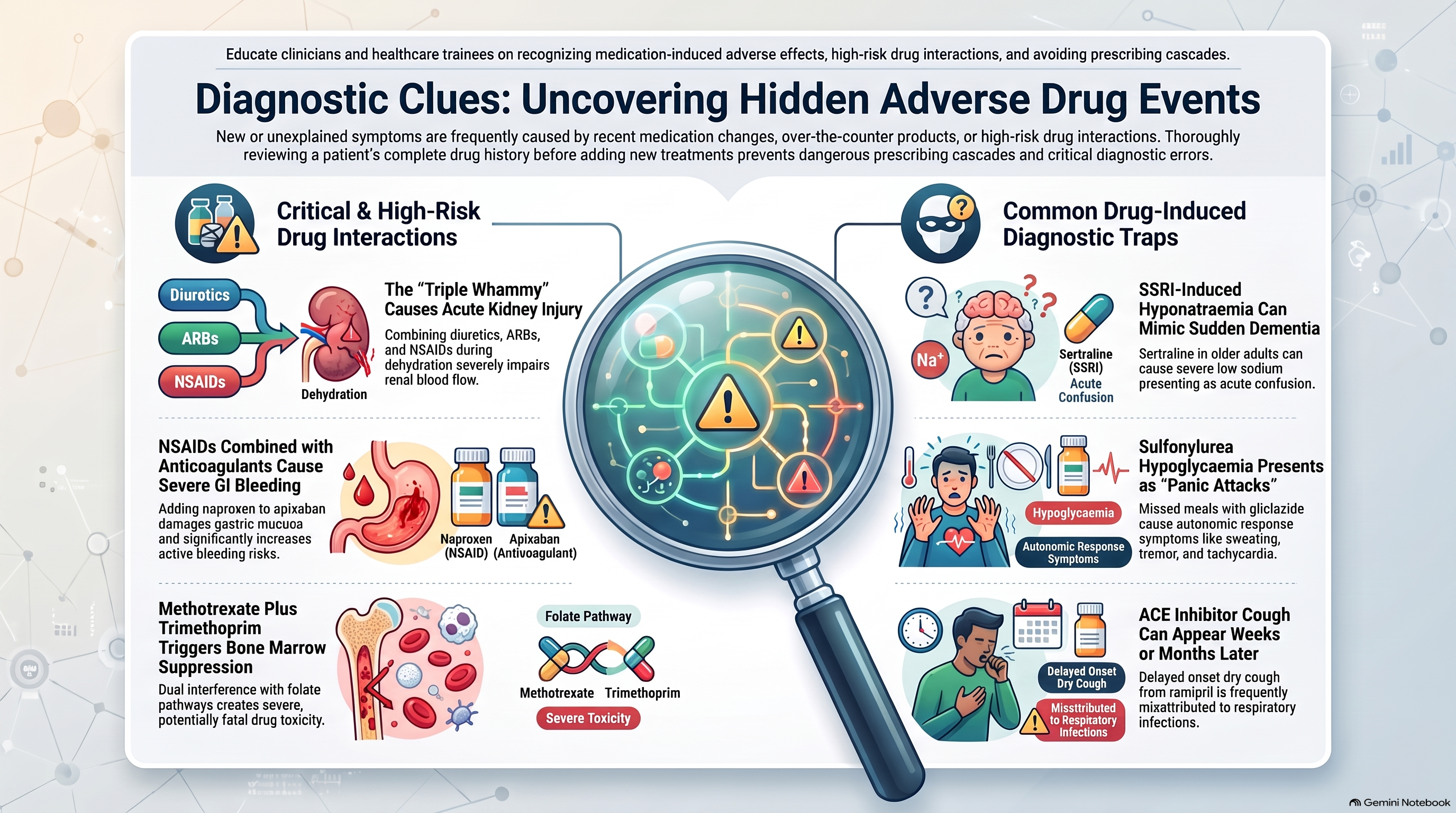
The Reveal: ACE Inhibitor–Induced Cough
ACE inhibitors can cause a persistent, non-productive cough. The timing varies, so a delayed onset does not exclude the medication.
After assessing other possible causes, the clinician stops ramipril and selects an appropriate alternative, often an angiotensin receptor blocker. Blood pressure, kidney function and potassium require follow-up.
The cough gradually resolves. Improvement may take several weeks and occasionally longer. Persistent symptoms still require reassessment. CHEST
The Diagnostic Trap
Adding repeated treatments for cough while continuing the culprit creates a prescribing cascade.
Take-Home Message
Before adding another medicine for a new symptom, check whether an existing medicine could be causing it.
Case 2: “She Was Fine Until Last Week”
A 79-year-old woman arrives with her daughter, who reports new confusion, nausea and unsteadiness.
“She is usually independent. Yesterday, she could not remember how to use the microwave.”
There is no fever or focal neurological deficit. She appears neither dehydrated nor fluid overloaded.
Blood tests reveal sodium of 119 mmol/L. Her previous sodium was 138.
The Hidden Clue
Sertraline was started three weeks earlier. Her symptoms developed after treatment began.
The Reveal: Suspected SSRI-Associated Hyponatraemia
SSRIs can cause hyponatraemia, often through inappropriate antidiuretic hormone activity. Older adults are particularly vulnerable.
However, the medication history is a clue, not proof. The assessment includes volume status, serum and urine osmolality, urine sodium and investigation for other causes. Adrenal insufficiency and relevant thyroid dysfunction must be considered before establishing SIADH.
She requires urgent hospital assessment because she has significant hyponatraemia with neurological symptoms. Sertraline is withheld. Treatment depends on severity and mechanism; severe symptoms may require carefully monitored hypertonic saline. Sodium correction must be controlled to avoid neurological injury. medsafe.govt.nz
The Diagnostic Trap
Calling this dementia—or assuming a urinary infection—without checking electrolytes could delay treatment.
Take-Home Message
New confusion after a medication change deserves prompt assessment. Review drugs and electrolytes early.
Case 3: “It Was Only an Over-the-Counter Painkiller”
A 73-year-old man presents with dizziness, nausea and reduced urine output.
He takes losartan and hydrochlorothiazide for hypertension. During a back-pain flare, he began taking ibuprofen regularly.
Then he developed diarrhoea and continued all his medicines while drinking very little.
His blood pressure is 94/60. Creatinine has risen from 95 to 238 micromol/L, and potassium is 5.8 mmol/L.
The Hidden Clue
An ARB, a diuretic and an NSAID were combined during dehydration.
The Reveal: Acute Kidney Injury from the “Triple Whammy”
The diuretic reduces circulating volume. The ARB affects pressure regulation within the kidney. The NSAID reduces protective prostaglandin activity and renal blood flow.
Together, especially during dehydration, they can substantially impair kidney function.
He needs urgent assessment, including an ECG and evaluation of hyperkalaemia. Stop the NSAID and temporarily withhold relevant medicines according to the clinical assessment. Restore volume cautiously where appropriate and monitor kidney function, potassium and urine output.
After recovery, review which medicines should restart and provide an individualised plan for future illness. medsafe.govt.nz
The Diagnostic Trap
A prescription list may be incomplete because patients do not consider pharmacy-bought painkillers to be medicines.
Take-Home Message
Ask specifically about ibuprofen, naproxen, supplements and other non-prescription products.
Case 4: “I Think I Am Having Panic Attacks”
A 68-year-old man describes episodes of sweating, shaking and a racing heart.
They usually happen late in the morning. Sometimes he becomes irritable or struggles to concentrate.
He takes gliclazide for type 2 diabetes. Recently, he started skipping breakfast to lose weight.
During an episode, his capillary glucose is 2.7 mmol/L.
The Hidden Clue
His symptoms occur after taking a medicine that stimulates insulin release without eating his usual meal.
The Reveal: Sulfonylurea-Associated Hypoglycaemia
For an alert patient who can swallow safely, give 15 grams of fast-acting carbohydrate and recheck glucose after 15 minutes. Repeat treatment if glucose remains below 4 mmol/L.
If consciousness is impaired or swallowing is unsafe, give nothing orally. Emergency treatment may involve intravenous glucose or glucagon, depending on the setting.
Sulfonylurea-associated hypoglycaemia can recur after initial improvement, so severe or recurrent episodes require medical observation. Review the dose, kidney function, meals and suitability of the treatment regimen. guidelines.diabetes.ca
The Diagnostic Trap
Sweating, tremor and palpitations can resemble anxiety. A bedside glucose check may reveal the explanation immediately.
Take-Home Message
Check glucose early in a patient with diabetes who develops unusual behaviour, confusion or “panic-like” symptoms.
Case 5: “The Arthritis Improved—Then the Black Stools Started”
A 76-year-old woman presents with weakness, dizziness and black, sticky stools.
She takes apixaban for atrial fibrillation. Ten days ago, she began naproxen for knee pain.
Her pulse is 112 and blood pressure 98/62. Haemoglobin has fallen from 126 to 78 g/L.
The Hidden Clue
An NSAID was added to an anticoagulant.
The Reveal: Gastrointestinal Bleeding in the Setting of a High-Risk Drug Combination
NSAIDs can damage gastrointestinal mucosa and increase bleeding risk when combined with a direct oral anticoagulant. sps.nhs.uk
She requires emergency transfer, resuscitation and investigation of the bleeding source. Naproxen is stopped and apixaban is withheld during active significant bleeding. The hospital team determines the need for blood products, endoscopic treatment and any anticoagulant reversal intervention.
Restarting anticoagulation requires a considered assessment of haemostasis, recurrent bleeding risk and stroke risk. It should not simply be abandoned indefinitely. thrombosiscanada.ca
The Diagnostic Trap
Identifying the interaction does not remove the need to investigate the lesion that bled.
Take-Home Message
Before prescribing an NSAID, check for anticoagulants, antiplatelets, previous ulcers and other bleeding risks.
Case 6: “The Antibiotic Was Supposed to Help”
A 61-year-old woman with rheumatoid arthritis presents with painful mouth ulcers, bruising and profound fatigue.
She takes methotrexate 20 mg once weekly and folic acid. Recently, she received trimethoprim-sulfamethoxazole for a urinary infection.
Her temperature is 38.4°C. Blood tests show severe neutropenia, thrombocytopenia and worsening kidney function.
The Hidden Clue
A new antibiotic was added to methotrexate.
The Reveal: Methotrexate Toxicity Associated with a Drug Interaction
Trimethoprim and methotrexate both interfere with folate pathways. The combination can cause severe bone marrow suppression; impaired methotrexate clearance can further increase toxicity.
Stop both medicines and arrange emergency hospital care. Fever with severe neutropenia demands immediate assessment and treatment through the neutropenic sepsis pathway.
Specialist management may include folinic acid rescue and supportive treatment. Routine folic acid supplementation does not make this combination safe.
Trimethoprim and trimethoprim-sulfamethoxazole should generally be avoided in patients taking methotrexate. Also verify that methotrexate is being taken weekly, since accidental daily dosing is another serious cause of toxicity. sps.nhs.uk
The Diagnostic Trap
An antibiotic may look like a routine short course while creating a dangerous interaction with a long-term medicine.
Take-Home Message
Mouth ulcers, unexplained bruising or fever in someone taking methotrexate should trigger an urgent toxicity assessment.
Closing
Six patients, six medication mysteries.
The important clues were a new prescription, a delayed adverse effect, an over-the-counter product, a missed meal and a dangerous combination.
Medication review means more than reading a list. Confirm what the patient actually takes, the dose, the timing, recent changes and non-prescription products. Then ask whether treatment could explain the new symptoms—while continuing to assess other causes.
Listen and learn for your medical exams with case-based episodes at TopMedCast.com. Test your clinical reasoning and strengthen your exam preparation at TopQBank.com.
This content is for educational purposes only and does not constitute medical advice or clinical guidance. Read the full disclaimer.