Six Secondary Hypertension Cases for TopMedCast
Introduction
Welcome to TopMedCast. Most hypertension is primary, but some patients have an identifiable underlying cause. These six fictional cases show how clinical clues can guide investigation and treatment.
Before escalating medication, confirm accurate blood pressure readings, review adherence and check for contributing medicines or substances.
Case 1. Persistent Hypertension and Low Potassium
The Presentation
A 46-year-old woman has persistently elevated home blood pressure despite amlodipine, valsartan and chlorthalidone. Her average reading is 164/98 mmHg.
She reports muscle cramps. Potassium is 3.0 mmol/L and remains low despite supplementation. Kidney function is stable.
She takes her medicines consistently and does not use licorice or stimulant products.
Assessment and Investigation
Primary aldosteronism is an important possibility. Diuretic-associated hypokalemia can reveal the condition; normal potassium would not exclude it.
Measure aldosterone, renin and potassium. Correct hypokalemia because it can suppress aldosterone and produce a misleading result.
Review interfering medicines and follow an appropriate testing protocol. Do not abruptly withdraw essential treatment.
Suppressed renin with inappropriately elevated aldosterone supports further evaluation. Interpret the ratio alongside the actual values and laboratory thresholds.
Management and Learning Point
Refer for specialist assessment. Suitable unilateral disease may be treated surgically; bilateral disease or patients not pursuing surgery generally receive a mineralocorticoid receptor antagonist, with potassium and renal monitoring.
An adrenal nodule on CT alone does not reliably establish which gland is responsible. www.endocrine.org
Case 2. Worsening Hypertension and Sudden Pulmonary Edema
The Presentation
A 72-year-old man with peripheral arterial disease develops increasingly difficult-to-control hypertension.
He has two hospital admissions for sudden severe breathlessness and pulmonary edema. Between episodes, he has little peripheral edema.
Creatinine rises substantially after an ACE inhibitor dose increase. Examination identifies an abdominal bruit.
Assessment and Investigation
The pattern raises concern for renovascular disease, particularly significant bilateral renal artery stenosis or stenosis affecting a solitary functioning kidney.
A creatinine rise alone is not diagnostic. Review volume status, medicines and other causes of acute kidney injury.
Renal artery Doppler ultrasound, CT angiography or MR angiography may be appropriate, selected according to renal function, local expertise and suitability.
Management and Learning Point
Acute pulmonary edema requires emergency treatment.
Long-term care includes blood pressure control and cardiovascular risk reduction, with close renal monitoring.
Routine stenting is not beneficial for every atherosclerotic renal artery stenosis. Recurrent flash pulmonary edema is a high-risk presentation warranting specialist assessment for possible revascularization. pmc.ncbi.nlm.nih.gov
Case 3. “Panic Attacks” With Blood Pressure Surges
The Presentation
A 38-year-old man describes episodes of pounding headache, sweating and a racing heart lasting about 20 minutes.
During attacks, his home blood pressure reaches 210/110 mmHg. Between episodes, it is much lower.
The episodes have been attributed to anxiety, but they sometimes occur without emotional stress. He does not use stimulants.
Assessment and Investigation
Pheochromocytoma is uncommon, but this pattern warrants investigation.
Initial testing uses plasma free metanephrines or 24-hour urinary fractionated metanephrines. Appropriate collection conditions matter; stress and medicines can produce misleading elevations.
Borderline results require careful interpretation. Imaging generally follows convincing biochemical evidence.
Management and Learning Point
Refer to endocrinology for coordinated assessment and treatment.
For a functioning tumor, preoperative preparation generally includes alpha blockade. A beta blocker, if needed, is introduced only after adequate alpha blockade. Starting beta blockade first can provoke dangerous hypertension.
Severe hypertension with acute organ dysfunction requires emergency care.
Do not dismiss the episodes as anxiety—but do not diagnose a tumor from symptoms alone. academic.oup.com
Case 4. Resistant Hypertension and Unrefreshing Sleep
The Presentation
A 54-year-old man has elevated blood pressure despite three antihypertensive medicines, including a diuretic.
He reports morning headaches, daytime sleepiness and difficulty concentrating. His partner describes loud snoring and repeated pauses in breathing.
He has obesity and sometimes struggles to stay awake while driving.
Assessment and Investigation
Obstructive sleep apnea is a likely contributor to his hypertension.
Ask about snoring, witnessed apneas, nocturnal choking, sleep quality and daytime impairment.
A screening questionnaire can help identify risk, but it does not establish the diagnosis. Arrange appropriate sleep testing through the local pathway.
Management and Learning Point
Management may include CPAP, weight management and other sleep-service recommendations.
Continue treating hypertension and monitor the response. CPAP may improve blood pressure, but it does not reliably eliminate the need for medication.
Address driving safety promptly when sleepiness impairs alertness.
Sleep history belongs in the assessment of difficult-to-control hypertension. American Heart Association
Case 5. Hypertension With Bruising and Muscle Weakness
The Presentation
A 42-year-old woman develops worsening hypertension and new diabetes.
Over the past year, she has gained central weight, developed easy bruising and noticed difficulty rising from a chair. Examination shows broad purple abdominal striae and proximal muscle weakness.
She does not report taking steroid tablets.
Assessment and Investigation
The combination raises concern for Cushing syndrome.
First review all glucocorticoid exposure—including injections, inhalers, creams and supplements. Asking only about tablets can miss an important cause.
For suspected endogenous cortisol excess, appropriate initial tests include an overnight dexamethasone suppression test, late-night salivary cortisol or 24-hour urinary free cortisol. Choose testing according to the patient’s circumstances.
A random serum cortisol is not an appropriate screening test.
Management and Learning Point
Abnormal screening requires endocrinology assessment and confirmation before investigating the source.
Treat associated hypertension and metabolic complications while arranging care.
If prescribed glucocorticoids are implicated, do not abruptly discontinue prolonged treatment.
Weight gain alone is nonspecific; progressive bruising, broad purple striae and proximal weakness strengthen the concern. Endocrine Society
Case 6. Hypertension in a Young Adult With Weak Femoral Pulses
The Presentation
A 24-year-old man is found to have repeated arm blood pressure readings around 170/95 mmHg.
He reports headaches and leg fatigue when running. Examination identifies diminished, delayed femoral pulses and a murmur over the back.
Correctly measured leg systolic pressure is substantially lower than arm pressure.
Assessment and Investigation
Consider coarctation of the aorta.
Measure blood pressure in both arms and a lower limb, using appropriate cuffs. An upper-to-lower limb systolic difference greater than 20 mmHg is concerning in the appropriate context.
Arrange echocardiography and specialist assessment. CT or MR angiography can define the anatomy.
Management and Learning Point
Refer to an adult congenital heart disease service. Significant coarctation may require catheter-based or surgical intervention, alongside blood pressure treatment.
Long-term follow-up remains necessary after repair because hypertension, recurrent narrowing and aortic complications can occur.
In a young person with hypertension, examine the femoral pulses—not just the arms. PMC
Closing
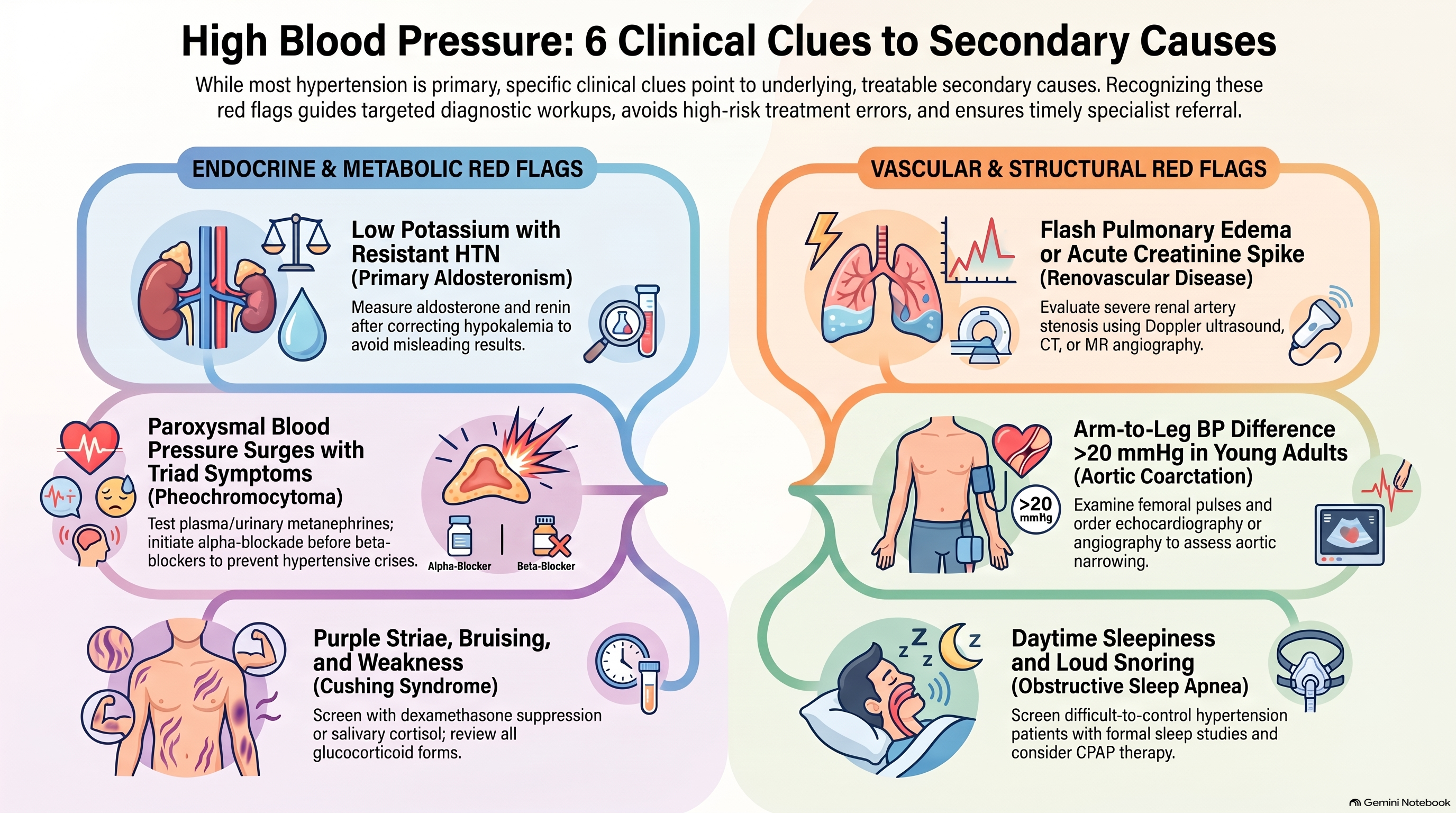
These cases highlight six clues: hypokalemia, recurrent pulmonary edema, episodic adrenergic symptoms, disturbed breathing during sleep, features of cortisol excess and an arm–leg blood pressure difference.
They guide investigation, but none establishes a diagnosis alone. More than one contributor may be present.
This is TopMedCast. Continue learning at TopMedCast.com and strengthen your clinical reasoning with practice questions at TopQBank.com.
This content is for educational purposes only and does not constitute medical advice or clinical guidance. Read the full disclaimer.