Key points
A Practical Approach to Assessment, Treatment and Follow-Up
Introduction
Welcome to TopMedCast. A patient comes in with poor sleep, fatigue, headaches or difficulty concentrating. Another says, “I worry all the time,” or “I do not feel like myself anymore.”
Depression and anxiety often present through physical symptoms. They may occur together, affect relationships and work, and make managing other illnesses more difficult.
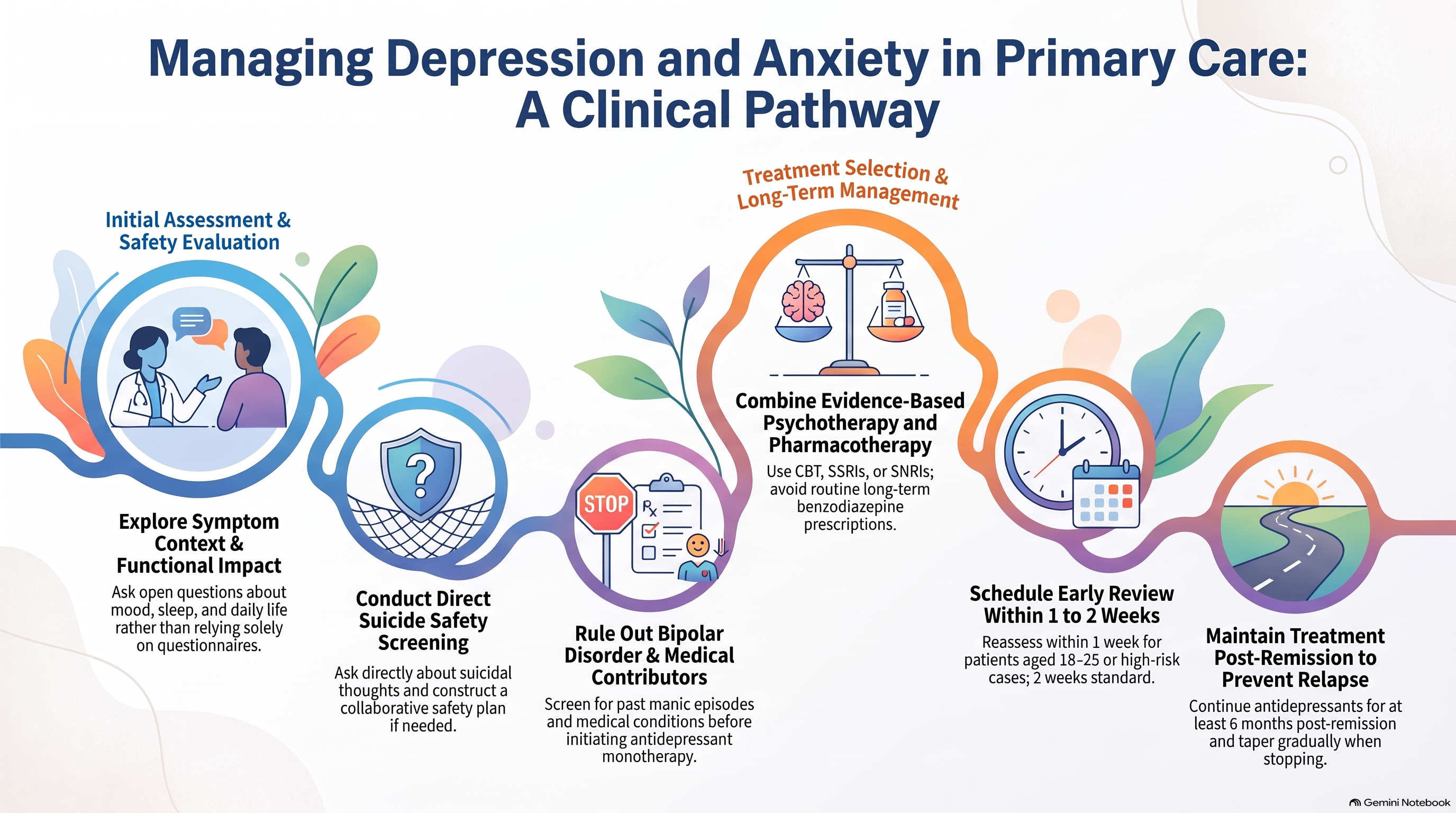
Today, we will follow a structured approach: establish safety, take a focused history, assess mental state, consider alternative diagnoses, agree on treatment and arrange follow-up.
This episode focuses on adults.
1. Initial Assessment
Start With the Patient’s Main Concern
Begin with an open question: “What has been most difficult for you recently?”
Give the patient time to explain. Explore how symptoms affect daily life, rather than moving immediately to a questionnaire or prescription.
Ask about eating, sleeping, self-care, work and relationships. Establish whether the patient has support and whether they feel safe at home.
Identify Immediate Concerns
Urgent assessment is needed for suicidal intent, a recent attempt, psychosis, mania, severe agitation or inability to meet basic needs.
Severe intoxication, withdrawal or a possible acute medical illness also changes the immediate plan.
Do not assume that chest pain, breathlessness or palpitations are anxiety without considering the clinical context.
2. History
Explore Depressive Symptoms
Ask about low mood and loss of interest or pleasure.
Then explore changes in sleep, appetite, energy, concentration and movement, along with guilt, hopelessness and thoughts of death.
Establish duration, persistence and functional impact. A major depressive episode generally involves symptoms for at least two weeks, including depressed mood or loss of interest, with additional symptoms and clinically significant distress or impairment.
A diagnosis requires assessment of the whole presentation—not simply counting symptoms.
Explore Anxiety Symptoms
Ask what the patient worries about, how difficult it is to control the worry and whether they avoid activities because of anxiety.
Explore restlessness, irritability, muscle tension, poor sleep and difficulty concentrating.
Ask about panic attacks: sudden episodes of intense fear with symptoms such as palpitations, trembling, breathlessness or dizziness.
Distinguish persistent generalised worry from panic disorder, social anxiety, trauma-related symptoms and obsessive-compulsive symptoms. These conditions may need different treatment approaches.
Understand the Context
Ask about previous episodes, treatments, hospital admissions and what helped or caused problems.
Review family psychiatric history, physical illness, medicines and substance use.
Explore bereavement, relationship difficulties, financial stress, discrimination, isolation and trauma sensitively. The patient does not need to disclose every detail at the first visit.
Identify protective relationships, coping strategies and barriers to care.
3. Safety Assessment
Ask Directly About Suicide
Use clear, compassionate language:
“Have things felt so difficult that you have wished you were dead?”
“Have you thought about ending your life?”
If the answer is yes, explore intent, a plan, access to means, preparations and previous attempts.
Ask about recent self-harm, substance use, severe agitation, psychotic symptoms and the patient’s ability to stay safe.
Protective factors matter, but they do not cancel concerning findings.
A questionnaire score or a “low-risk” label cannot reliably predict suicide or replace an individual assessment.
Act on the Findings
If there is imminent danger, arrange emergency assessment. Keep the patient supported and supervised while organising care.
For patients suitable for outpatient management, develop a collaborative safety plan covering warning signs, coping strategies, supportive contacts, professional help and reducing access to potentially lethal means.
A promise not to self-harm is not a substitute for a safety plan.
Involve a trusted person with consent when appropriate. Explain the limits of confidentiality when there is a serious immediate safety concern, following local requirements.
Document the assessment, reasoning and agreed plan.
4. Mental State and Physical Assessment
Examine More Than Mood
Assess appearance, behaviour, speech, mood, affect, thought content, perception, cognition, insight and judgment.
Look for psychomotor slowing, agitation, disorganisation or psychotic symptoms.
Perform a physical examination guided by the history. Consider vital signs, weight changes and findings suggesting a contributing medical condition.
Consider Medical and Medication Contributors
Thyroid disease, anaemia, sleep disorders, chronic pain and other illnesses may contribute to symptoms.
Review medicines and substances that can affect mood, sleep or anxiety. Alcohol may temporarily reduce distress while worsening sleep and mood over time.
Order targeted tests when indicated. Broad laboratory testing is not necessary for every patient.
5. Diagnosis
Use Questionnaires to Support Assessment
The PHQ-9 and GAD-7 can help measure symptom burden and track change.
They support the clinical interview; they do not establish a diagnosis on their own.
Always explore an answer suggesting self-harm or death wishes directly.
Check for Bipolar Disorder
Before prescribing an antidepressant, ask about previous periods of unusually elevated or irritable mood, increased activity, reduced need for sleep, impulsive behaviour or feeling exceptionally powerful.
Reduced need for sleep means sleeping less without feeling tired—not simply lying awake with insomnia.
Ask about previous activation with antidepressants and family history of bipolar disorder.
Suspected bipolar disorder requires further assessment. Avoid treating it as straightforward unipolar depression with antidepressant monotherapy.
Distinguish Distress From Disorder
Grief, adjustment difficulties and understandable stress can resemble depression or anxiety. They still deserve care.
Assess severity, duration, impairment and associated symptoms. Bereavement does not exclude a depressive episode.
6. Agree on a Treatment Plan
Use Shared Decision-Making
Explain the working diagnosis and discuss treatment choices.
Ask what matters most to the patient: improving sleep, returning to work, reducing panic or reconnecting with family.
Consider preferences, previous response, severity, access, cost and adverse effects.
Treatment may include psychological therapy, medication or both.
Psychological Treatment
Cognitive behavioural therapy is effective for depression and many anxiety disorders.
Behavioural activation can help depression by supporting a gradual return to meaningful activities.
Other appropriate therapies include interpersonal therapy for depression and disorder-specific psychological treatments.
For less severe depression, guided self-help or psychological treatment may be a suitable starting point. Medication can still be considered when it is the patient’s informed preference.
More severe depression may benefit from combining medication and psychotherapy.
Practical Supports
Agree on achievable steps around sleep, regular meals, physical activity and social contact.
Help address practical pressures and connect the patient with relevant community supports.
Avoid presenting lifestyle changes as a test of motivation. A severely depressed patient may need help taking even small steps.
7. Medication
Select Treatment for the Individual
SSRIs are commonly used for depression and anxiety. SNRIs and other antidepressants may be appropriate depending on the presentation.
Consider previous response, interactions, physical conditions, pregnancy or breastfeeding, and the consequences of adverse effects.
Examples of important considerations include sexual dysfunction, gastrointestinal symptoms, sleep disturbance, weight changes and medication toxicity in overdose.
When anxiety or panic is prominent, starting at a lower dose and increasing gradually can improve tolerability.
Explain What to Expect
Benefits develop gradually. Early side effects may occur before improvement, and a fuller response can take several weeks.
Discuss nausea, sleep changes, activation and sexual side effects before starting treatment.
Tell patients to seek prompt help for worsening suicidal thoughts, severe agitation or possible manic symptoms.
Check interactions and avoid unsafe combinations of serotonergic medicines.
Benzodiazepines
Benzodiazepines are not a routine long-term treatment for anxiety. Risks include dependence, sedation, impaired driving and falls.
They are not recommended as ongoing treatment for panic disorder. Any exceptional short-term use requires a clear indication and review plan.
Do not abruptly stop a benzodiazepine in someone who may be dependent; withdrawal needs careful management.
8. Follow-Up
Arrange Review Before the Patient Leaves
After starting an antidepressant, review is usually appropriate within two weeks.
Arrange review within one week for adults aged 18 to 25 or when suicide risk is a particular concern. Other circumstances may require earlier or more frequent contact.
At review, assess safety, adverse effects, adherence, symptoms and function.
Ask about practical improvement: “Are you sleeping more consistently?” “Have you managed to return to activities you value?”
Measure Progress
Use the same symptom measure when helpful, alongside the patient’s experience.
The aim is meaningful recovery and remission—not merely a lower score.
If the patient misses an appointment, consider whether proactive contact is needed, particularly when safety concerns are present.
9. When Improvement Is Limited
Reassess Before Changing Treatment
Check whether the diagnosis remains appropriate, the medicine is being taken, and the dose and duration constitute an adequate trial.
Explore adverse effects, substance use, ongoing stress and access to therapy.
Reconsider bipolar disorder, other psychiatric conditions and medical contributors.
Options may include dose optimisation, switching medication, adding psychotherapy or specialist consultation. Complex combinations and augmentation need appropriate expertise and monitoring.
Do not leave someone indefinitely on ineffective treatment without review.
10. Referral and Special Circumstances
When Specialist Care Is Needed
Arrange urgent assessment for imminent suicide risk, mania, psychosis, severe self-neglect or rapidly worsening illness.
Seek specialist input for diagnostic uncertainty, suspected bipolar disorder, repeated treatment failure or complex comorbidity.
Severe or life-threatening depression may require hospital care and treatments such as electroconvulsive therapy.
Pregnancy, Postpartum and Older Adults
Pregnancy and breastfeeding require individual discussion of the risks of illness and treatment. Do not advise abrupt medication discontinuation without assessment.
Postpartum psychosis is an emergency.
In older adults, consider falls, cognitive changes, hyponatraemia risk, interactions and physical illness.
11. Relapse Prevention
Plan Beyond the First Improvement
For depression, antidepressant treatment commonly continues for at least six months after remission. Recurrent or severe illness may require longer treatment.
Anxiety disorders may also need sustained treatment; duration depends on the diagnosis, response and relapse risk.
Review regularly and identify early warning signs.
When stopping an antidepressant, taper gradually according to the medicine, duration of use and individual response. Withdrawal symptoms can resemble relapse, so assess their timing and pattern.
Closing
Depression and anxiety care begins with listening and safety.
Understand the symptoms and context, check for alternative diagnoses, agree on treatment and maintain follow-up. Recovery often needs adjustments, practical support and a continuing therapeutic relationship.
In Canada, people experiencing suicidal distress can call or text 9-8-8. Immediate danger requires emergency services.
Listen to practical clinical episodes at TopMedCast.com, then strengthen your clinical reasoning with practice questions at TopQBank.com.
This is TopMedCast. Thank you for listening to Depression and Anxiety in Primary Care: Assessment, Treatment and Follow-Up. Continue learning at TopMedCast.com and strengthen your clinical reasoning with practice questions at TopQBank.com.
Sources for Show Notes
Sources include Canadian CANMAT and CAMH guidance on depression, anxiety, bipolar assessment and suicide safety, together with NICE treatment and follow-up recommendations. PMC
Canada’s suicide crisis support number is 9-8-8. Canada.ca
This content is for educational purposes only and does not constitute medical advice or clinical guidance. Read the full disclaimer.