Key points
- Your experience matters: PRA offers eligible internationally trained doctors a pathway to Canadian licensing without repeating a full residency. Find the right provincial program: Match your training and practice experience to the requirements, including Saskatchewan’s SIPPA. Plan licensing and immigration together: Prepare your credentials, examinations and immigration pathway to move confidently toward a medical career in Canada.
Show notes & transcript
Build Your Medical Career in Canada
Practice Ready Assessment and Immigration Pathways for International Doctors
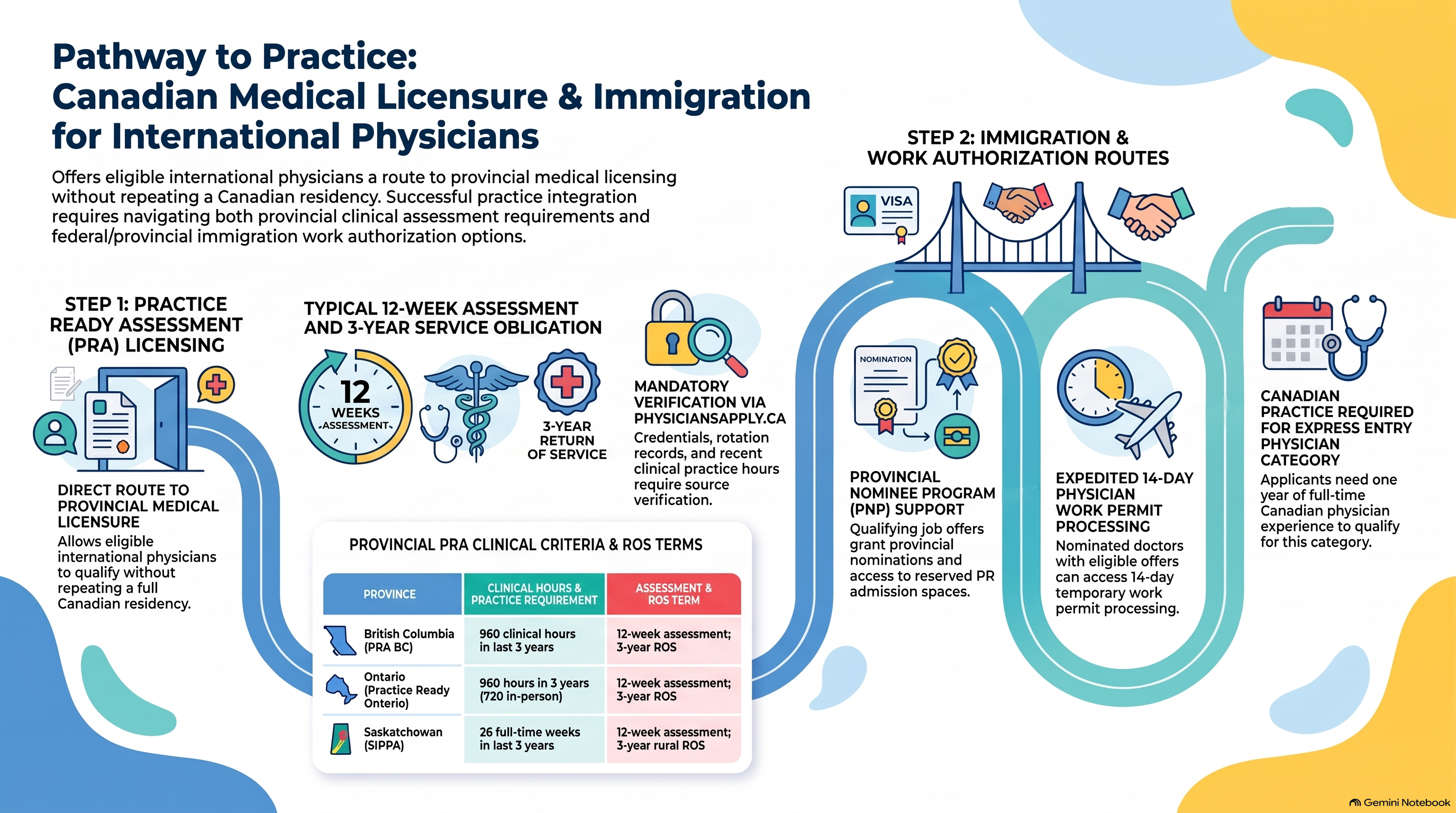
Your medical training and clinical experience can open the door to a new professional chapter in Canada. For eligible internationally trained physicians, Practice Ready Assessment (PRA) offers a pathway to provincial licensing without repeating a full Canadian residency.
These programs allow experienced doctors to demonstrate their skills in Canadian clinical settings and prepare to serve communities where their contribution matters. Most pathways focus on family medicine, while some also offer opportunities for specialists.
Choosing the right province is the first step. Each program has its own eligibility criteria, assessment process and service commitments. Medical licensing and immigration are separate processes that can be planned together.
Provincial Opportunities
1. British Columbia — PRA-BC
PRA-BC offers experienced family physicians an opportunity to establish their practice in a community that needs their skills.
- Two years of postgraduate family medicine training and two years of independent practice.
- Seven required core rotations.
- At least 24 weeks and 960 clinical hours in the preceding three years.
- English proficiency and Therapeutics Decision-Making (TDM) requirements, with applicable exemptions.
- Regulatory eligibility, health-authority selection and clinical assessment.
- A three-year return-of-service commitment in an approved community.
2. Alberta — CPSA Practice Readiness Assessment
Alberta provides a sponsored pathway for qualified physicians to demonstrate their readiness and progress toward provincial registration.
- University-affiliated training, including four months of community primary care and eight weeks in at least three specified core disciplines.
- An accepted registration examination.
- At least one year of relevant practice or postgraduate training within the preceding three years.
- Approved sponsorship and TDM for family medicine, unless exempt.
- Usually three months of direct assessment followed by three months of supervised practice; the first stage may be waived.
- Service obligations are determined by the sponsorship or employment agreement.
3. Saskatchewan — SIPPA
The Saskatchewan International Physician Practice Assessment (SIPPA) offers a structured introduction to family practice in Saskatchewan, with accommodation and an honorarium during the program.
- At least 12 months of relevant postgraduate family medicine training.
- Three years of in-person independent practice if postgraduate training is shorter than 24 months.
- At least 26 full-time weeks of qualifying recent practice within three years.
- MCCQE, NAC or historical MCCQE Part II, TDM and English requirements.
- Orientation followed by a 12-week clinical assessment.
- A three-year commitment to an assigned underserved rural community.
4. Manitoba — PRA MB-FP
Manitoba combines assessment, orientation and subsequent mentorship to support physicians entering rural family practice.
- Two years of accredited family medicine training, or one year of training plus three years of family-practice experience in the preceding five years.
- CPSM eligibility, English proficiency and university selection requirements.
- Four-week orientation followed by a three-month assessment involving emergency care and two clinic placements.
- Rural return of service and mentorship after completion.
- Examination and immigration-status requirements must be confirmed for the current intake.
5. Ontario — Practice Ready Ontario
Practice Ready Ontario offers eligible Canadian citizens and permanent residents a pathway to contribute to primary care in communities with recruitment needs.
- Canadian citizenship or permanent residence.
- LMCC, or an eligible pending application.
- Four years of combined postgraduate training and independent practice, usually one year plus three years, or two years plus two years.
- Seven core rotations or accepted equivalents.
- At least 960 clinical hours within three years, including 720 in person.
- NAC or historical MCCQE Part II and TDM for verification.
- Twelve-week assessment and a three-year return-of-service commitment.
6. Nova Scotia — PACE
Nova Scotia’s PACE pathway helps eligible physicians demonstrate their readiness for office-based primary care. A separate hospitalist pathway is also available.
- Two years of training plus one year of independent practice, or one year of training plus two years of independent practice.
- Required core rotations or accepted equivalents.
- At least 450 relevant clinical hours in the preceding five years.
- English requirements, with possible exemptions.
- Competence-based assessment leading to defined or restricted registration, depending on the outcome.
- Employment and return-of-service agreements apply.
7. Newfoundland and Labrador — PRA-NL
PRA-NL offers experienced family physicians an opportunity to demonstrate their skills through a focused clinical assessment.
- CPSNL provisional-licensing eligibility letter.
- MCCQE or an accepted USMLE alternative.
- NAC or historical MCCQE Part II, plus TDM.
- At least 450 family-medicine hours in the preceding three years.
- Fewer than two previous failed Canadian PRA attempts.
- Competitive selection for a 12-week assessment.
- Training, language, sponsorship and service conditions must be confirmed.
8. Quebec — Restrictive Permit Pathway
For physicians with French proficiency, Quebec offers an institution-linked assessment pathway in the intended discipline.
- Equivalent postgraduate training and the required specialty designation.
- An accepted MCC examination or USMLE Step 2 CK.
- At least 12 months of relevant practice within three years.
- French proficiency and approved sponsorship.
- One observation week followed by 12 assessment weeks and ALDO-Québec.
- Practice within the permit’s authorized scope.
- Immigration through Quebec’s own selection system.
Immigration Pathways for Doctors
Canada offers several immigration routes that eligible physicians can explore alongside their licensing plans. Some applicants obtain permanent residence first; others pursue a supported position and work authorization where the provincial program permits it.
Provincial Nominee Program
A qualifying job offer or provincial support may provide a route to nomination and permanent residence. Eligible nominated physicians can also seek a supported work permit while their permanent-residence application is processed.
IRCC lists up to 5,000 reserved admission spaces for nominated doctors with qualifying offers or support. These are immigration spaces rather than PRA assessment seats. Quebec uses its own immigration system.
Faster Work-Permit Processing
Eligible nominated physicians may qualify for 14-day work-permit processing. Requirements include a qualifying full-time physician offer, provincial support, employer documentation, applicable T13 LMIA-exemption information, an upfront medical examination and a complete application with timely biometrics. Eligibility and approval requirements still apply.
Express Entry from Overseas
Experienced doctors may qualify through the Federal Skilled Worker Program. Main criteria include:
- One continuous year of qualifying paid skilled work within ten years.
- At least CLB 7 in each language skill.
- An immigration Educational Credential Assessment.
- At least 67 out of 100 eligibility points.
- Settlement funds unless exempt and admissibility to Canada.
Eligible candidates enter the Express Entry pool, where invitations depend on the applicable selection process and CRS ranking.
Opportunities After Canadian Practice
A physician Express Entry category may be available after at least one year of full-time Canadian physician experience within three years. Applicants must also qualify for an Express Entry program and receive an invitation.
Atlantic and Community Pathways
The Atlantic Immigration Program and rural or Francophone community pilots may offer additional options for physicians with qualifying positions from designated employers.
Take Your First Steps
- Identify your provincial pathway. Match your training, clinical experience and recent practice to the program’s criteria.
- Prepare your credentials. Gather your degree, training and rotation records, licences, references, certificates of good standing and clinical-hours evidence.
- Plan your examinations and language tests. Medical licensing and immigration may require different tests. IELTS Academic may meet licensing requirements; Express Entry uses IELTS General Training.
- Connect with the program or recruiting authority. Confirm assessment opportunities, sponsorship, community placements and immigration support.
- Prepare for your move. Coordinate your medical registration, work authorization and accompanying family members’ status.
Your experience has value. With the right preparation and a pathway that matches your qualifications, a medical career in Canada can become a realistic next step—bringing new professional opportunities and the chance to make a lasting contribution to your community.
Program requirements and immigration rules can change. Confirm current criteria with the provincial program and IRCC before applying.
This content is for educational purposes only and does not constitute medical advice or clinical guidance. Read the full disclaimer.