A Practical Approach to Diagnosis, Treatment and Prevention
Introduction
Welcome to TopMedCast. A patient wakes with a red, swollen, intensely painful big toe. Another has recurrent knee swelling and keeps receiving short courses of anti-inflammatory treatment.
Both may have gout—but treating each attack is only part of the job.
Today, we will cover assessment, important alternative diagnoses, flare treatment and long-term prevention. The aim is to relieve pain now and reduce the crystal burden that causes future attacks.
1. Understanding Gout
A Crystal Disease
Gout develops when monosodium urate crystals accumulate in joints and other tissues. An inflammatory response to these crystals causes a flare.
Over time, deposits may form tophi and damage joints.
Gout is influenced by genetics, kidney function, medicines and metabolic factors. Diet matters, but gout should not be presented as a personal failure.
An elevated serum urate level alone does not establish gout.
2. Initial Assessment
Is This an Uncomplicated Flare?
Assess the patient’s general condition, vital signs and ability to use the affected limb.
A hot, swollen joint may represent gout, another crystal arthritis or infection.
Look for systemic illness, skin infection, a recent joint procedure or other circumstances that increase concern for septic arthritis.
A previous diagnosis of gout does not explain every future swollen joint.
3. History and Examination
Establish the Pattern
Ask about onset, speed of progression, affected joints, previous episodes and recovery between attacks.
Gout often causes abrupt severe pain, but it can affect joints beyond the big toe.
Review kidney disease, stones, cardiovascular conditions, medicines, alcohol intake and previous gout treatment.
Ask whether prescribed urate-lowering medication is being taken consistently.
Examine the Joint and Surrounding Skin
Assess warmth, swelling, tenderness, movement and skin integrity.
Look for tophi, particularly around the ears, fingers, elbows and feet.
Determine whether the main problem is within the joint or surrounding tissues. Consider trauma, cellulitis and other inflammatory conditions.
4. Red Flags
Do Not Miss Septic Arthritis
Suspected septic arthritis requires urgent hospital assessment.
Fever may be absent. Neither reassuring blood tests nor a history of gout reliably excludes infection.
When appropriate, joint fluid should be obtained promptly for culture, cell count and crystal analysis. Crystals do not rule out coexisting septic arthritis.
In a stable patient, sampling is generally obtained before antibiotics. Sepsis or shock requires immediate treatment without an unsafe delay.
Avoid injecting corticosteroid into a joint when infection remains a concern.
5. Investigations
Interpret Serum Urate Carefully
Serum urate can fall during an acute flare. A result within the laboratory reference range does not exclude gout.
If suspicion remains strong, repeat the measurement at least two weeks after the flare settles.
Confirm Uncertain Cases
Joint aspiration is especially useful when the diagnosis is uncertain or infection is possible.
Ultrasound or dual-energy CT may help selected cases when aspiration is unavailable or inconclusive.
Assess kidney function and relevant comorbidities before choosing treatment. Baseline blood count and liver tests may also be appropriate before long-term medication.
6. Treating the Flare
Choose Treatment for the Patient
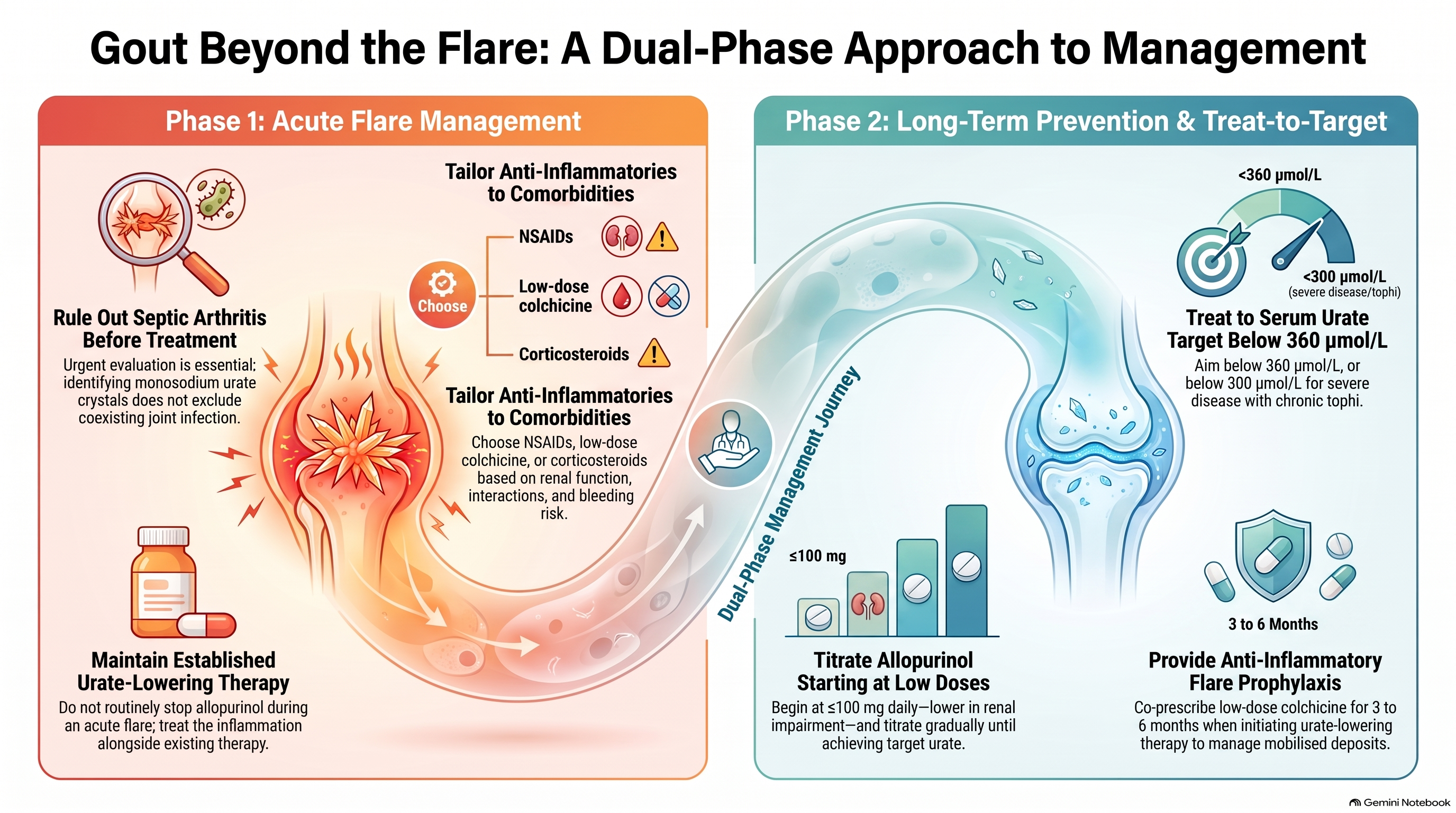
NSAIDs, low-dose colchicine and corticosteroids are common options. The choice depends on kidney function, interactions, bleeding risk and other illnesses.
Resting the affected joint and using a wrapped ice pack may help symptoms.
NSAIDs
Use an appropriate anti-inflammatory course when suitable.
Avoid or use particular caution with significant kidney disease, heart failure, gastrointestinal bleeding risk or anticoagulation.
Do not combine two NSAIDs. Consider gastroprotection when indicated.
Colchicine
Colchicine works best when started early.
A commonly used low-dose adult regimen is 1.2 milligrams initially, followed by 0.6 milligrams one hour later. Subsequent dosing must account for kidney and liver function, existing colchicine use and interactions.
Do not use the old practice of repeated high doses until diarrhoea develops.
Strong CYP3A4 or P-glycoprotein inhibitors can cause dangerous toxicity. Clarithromycin is an important example; combinations may be contraindicated, particularly with renal or hepatic impairment.
Corticosteroids
A short oral corticosteroid course may be appropriate when NSAIDs or colchicine are unsuitable.
Consider effects on glucose, mood and infection risk.
Intra-articular treatment may be useful for selected patients after infection has been appropriately excluded.
Continue Established Urate-Lowering Therapy
Do not routinely stop allopurinol during a flare. Treat the inflammation while maintaining the long-term plan, unless an adverse reaction or another clinical reason requires stopping it.
7. Long-Term Prevention
Who Should Receive Urate-Lowering Therapy?
Discuss long-term treatment with patients who have recurrent flares, tophi or gout-related joint damage.
After a first flare, kidney disease, markedly elevated urate or urinary stones may influence the decision.
Asymptomatic hyperuricaemia is generally not an indication to start medication solely to prevent gout.
Treat to Target
The usual serum urate target is below 360 micromoles per litre.
A lower target below 300 may be considered for tophi, chronic gouty arthritis or continuing frequent flares despite reaching the usual target.
The laboratory’s “normal range” is not the same as the treatment target.
8. Allopurinol
Start Low and Titrate
Allopurinol is commonly the preferred first-line treatment, including in chronic kidney disease.
Start at a low dose—usually no more than 100 milligrams daily, and lower when appropriate in kidney disease—then increase gradually using urate results and tolerability.
Kidney disease requires careful initiation and monitoring; it does not automatically mean that effective dose escalation is impossible.
Some patients need more than 300 milligrams daily. Avoid leaving everyone on a fixed dose without checking whether the target has been reached.
Discuss Important Safety Issues
Consider HLA-B*58:01 testing before treatment in populations with increased genetic susceptibility, according to applicable guidance.
Tell patients to stop allopurinol and seek prompt assessment for a new rash. Rash with fever, blistering, mucosal involvement or systemic symptoms requires urgent care.
Check interactions, especially with azathioprine or mercaptopurine. These combinations require specialist-directed management.
Febuxostat may be an alternative, but cardiovascular history and other factors influence its suitability.
9. Prevent Flares During Initiation
Explain Early Attacks
Flares may occur while urate deposits are being mobilised. This does not automatically mean treatment is failing.
Anti-inflammatory prophylaxis is commonly prescribed for three to six months, sometimes longer.
Low-dose colchicine is often used when suitable. The choice and dose depend on renal function, interactions and tolerability.
Starting urate-lowering therapy during a treated flare is acceptable under some guidelines; others generally favour waiting until it settles. Agree on timing and ensure the prevention plan is not forgotten.
10. Counselling and Follow-Up
Make the Plan Practical
Encourage a balanced diet, gradual weight management when appropriate, limiting excess alcohol and reducing sugar-sweetened drinks.
Explain that lifestyle changes support treatment but may not lower urate enough on their own.
Review contributing medicines where appropriate. Do not stop necessary cardiovascular treatment simply because the patient has gout.
Monitor Progress
Check serum urate during dose titration—often monthly—and adjust treatment until the agreed target is reached.
Review adverse effects, adherence, renal function and other monitoring needs.
Once stable, continue periodic review. Long-term treatment is usually ongoing; becoming symptom-free is not automatically a reason to stop it.
Arrange earlier reassessment for worsening symptoms, systemic illness or an attack that does not respond as expected.
Closing
Gout management has two connected goals: control inflammation during the flare and lower urate sufficiently to prevent further crystal deposition.
Confirm uncertain diagnoses, remain alert to infection, choose safe flare treatment and follow through with a treat-to-target plan.
This is TopMedCast. Continue learning at TopMedCast.com and strengthen your clinical reasoning with practice questions at TopQBank.com.
Sources for Show Notes
Guidance consulted includes NICE and the American College of Rheumatology on gout management, and SANJO guidance on septic arthritis. NICE
Medication safety information includes prescribing guidance for colchicine and allopurinol. NIH
This content is for educational purposes only and does not constitute medical advice or clinical guidance. Read the full disclaimer.