Mastering Headache in Primary Care
A Step by Step Approach to Assessment, Diagnosis and Management
TopMedCast podcast script for adult primary care
Introduction
Welcome to TopMedCast. When someone comes to us with a headache, our first task is to work out whether they need urgent care. We can then explore the history, examine them carefully and decide whether investigations are needed. From there, we can agree on treatment and follow-up.
Today, we will discuss migraine, tension-type headache, cluster headache and medication overuse. We will also look at the warning signs that suggest a serious underlying cause.
Step One. Initial Assessment
Before taking a detailed history, look at the patient. Do they appear unwell? Are they alert and communicating normally? Check their vital signs and look for new weakness, confusion or visual problems.
A sudden severe headache, reduced consciousness, a new neurological deficit, seizure, signs of meningitis or threatened vision requires emergency assessment. Improvement with pain relief does not rule out a serious cause, and neither does a normal examination.
Measure blood pressure, but interpret it in context. Do not assume that an elevated reading explains the headache. Severely elevated blood pressure with acute neurological, visual or other organ dysfunction suggests an emergency.
Step Two. Taking the History
How Did the Headache Begin?
Start by asking how the headache began.
What were you doing when it started? Did the pain build gradually, or did it become severe almost immediately?
Understanding the Pattern
Is this the first headache, the worst headache, or a change from the headaches you usually have?
Where is the pain? Does it feel like pressure, tightness or throbbing? How severe is it?
How long does each attack last? How many days each month do you have a headache?
Do you feel completely well between attacks, or is the pain always there?
Does walking or climbing stairs make it worse? Is it triggered by coughing, exertion or a change in position?
Associated Symptoms and Daily Impact
Do you have nausea, vomiting, sensitivity to light or sound, tearing, nasal symptoms, fever or neurological symptoms?
How is the headache affecting your sleep, work and everyday life?
If the patient describes visual or neurological symptoms, clarify how they develop, how long they last and whether they resolve completely. Ask whether visual loss affects one eye or both. A visual disturbance should not automatically be labelled migraine aura.
Previous Headaches and Medication Use
Review previous headaches, family history and responses to treatment. Ask about sleep, meals, caffeine and menstrual patterns where relevant.
Find out exactly how often the patient takes headache medication. Include medicines bought without a prescription and combination products. Count the days they use medication, rather than just the number of tablets.
Relevant Medical History
Ask about cancer, immunosuppression, pregnancy, recent delivery, head injury, anticoagulants and recent procedures. If other people at home have similar symptoms, consider an environmental exposure.
Step Three. Examination
General Assessment
Record temperature, pulse and blood pressure. Assess the patient’s general appearance, orientation, speech and level of consciousness.
Neurological Examination
Perform a focused neurological examination, guided by the history. This may include cranial nerves, strength, sensation, reflexes, coordination and gait.
Eye Examination
Check visual acuity, pupils, eye movements and visual fields. Look for a red eye and examine the optic discs for papilloedema where feasible. If you cannot see the discs clearly, do not document them as normal.
Other Focused Findings
Assess neck stiffness when infection is a concern. In an older adult with a new headache, examine the temporal arteries and ask about scalp tenderness, pain when chewing and visual symptoms.
Use the examination to explore the concerns raised by the history. One reassuring finding does not exclude every serious cause.
Step Four. Red Flags and What to Do About Them
Warning signs include systemic illness, neurological abnormalities, sudden onset, a new headache at an older age and a changing pattern. Pregnancy, papilloedema, positional symptoms, exertion, trauma and medication risks also deserve attention.
Thunderclap Headache
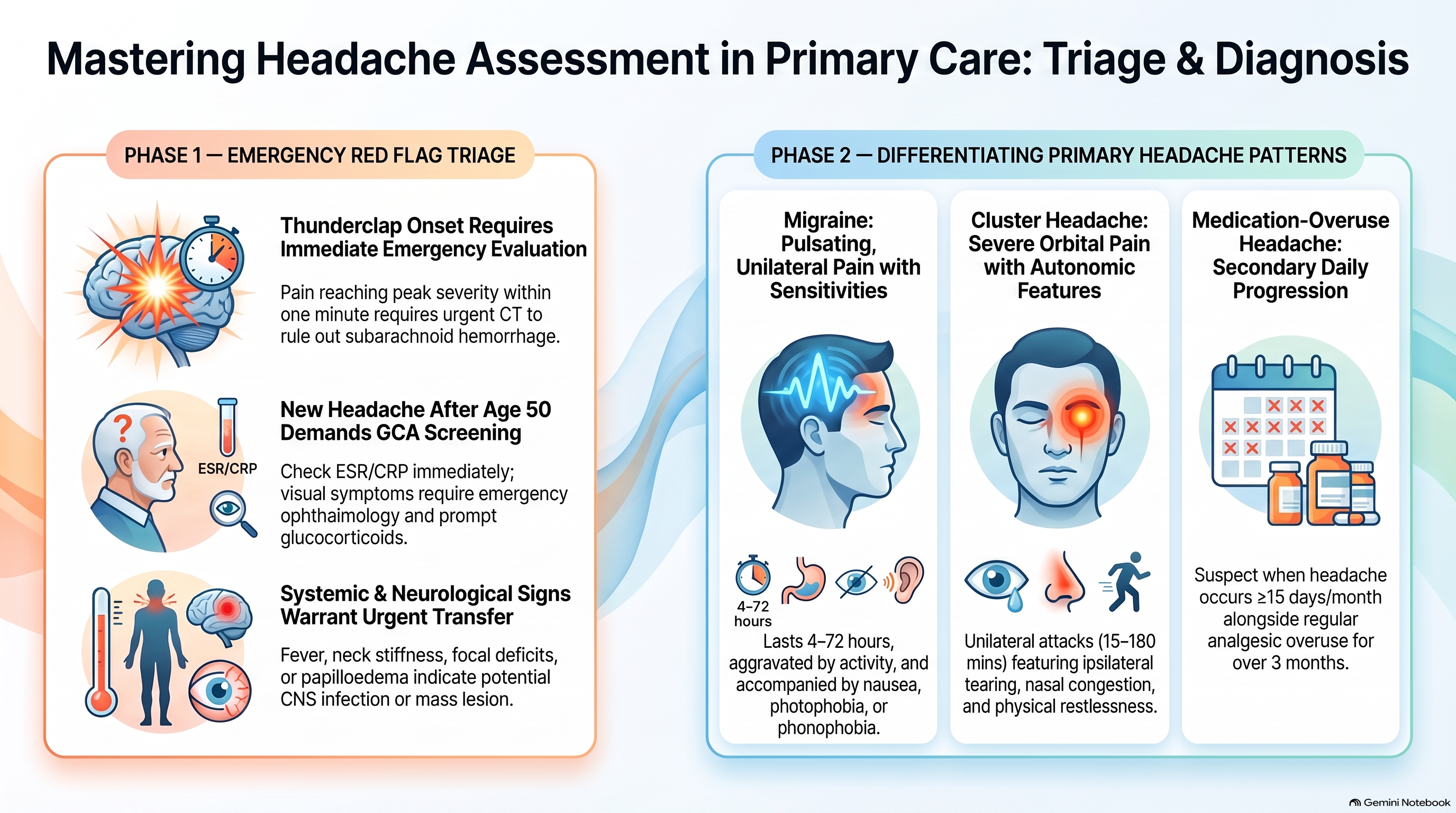
A headache that reaches maximum intensity within about a minute needs immediate emergency evaluation. Consider subarachnoid haemorrhage and other vascular causes.
Record the exact onset time. Emergency investigation generally begins with a non-contrast CT scan. Further testing depends on when the scan was performed, its quality and whether concern remains. Do not wait for an outpatient scan.
Fever or Systemic Illness
Headache with fever, neck stiffness, confusion, reduced consciousness, seizures or a non-blanching rash raises concern for meningitis or encephalitis.
The classic features may not all be present. Arrange emergency transfer. Suspected bacterial meningitis requires prompt antibiotics. Lumbar puncture should be performed when safe and should not significantly delay treatment.
New Headache After Age Fifty
Consider giant cell arteritis, particularly when there is scalp tenderness, jaw pain when chewing, visual disturbance or symptoms of polymyalgia rheumatica.
Obtain ESR, CRP and a full blood count, preferably before treatment if doing so causes no delay. When suspicion is strong, begin glucocorticoids immediately and arrange urgent specialist assessment. Do not wait for ultrasound or biopsy.
Without visual ischaemia, prednisone or prednisolone forty to sixty milligrams daily is a usual initial regimen. Visual symptoms require immediate ophthalmology and emergency assessment, and intravenous treatment may be needed.
Normal inflammatory markers do not completely exclude giant cell arteritis.
Progressive Headache or a History of Cancer
A new or worsening headache in someone with cancer or immunosuppression requires careful assessment. Focal neurological deficits, seizures, cognitive changes and unexplained vomiting add to the concern.
Papilloedema or neurological deterioration requires emergency assessment. Morning headache on its own does not establish a diagnosis of malignancy.
Pregnancy and the Postpartum Period
Have a lower threshold for urgent assessment when a headache is new, severe or different during pregnancy or after delivery.
Check blood pressure and consider preeclampsia, including postpartum preeclampsia. Persistent headache with visual disturbance or upper abdominal pain is particularly concerning.
Other possibilities include cerebral venous thrombosis and complications following neuraxial procedures. Assess the patient before assuming the headache is migraine or related to a spinal procedure.
Painful Red Eye
Headache with eye pain, reduced vision, halos or redness may indicate acute angle-closure glaucoma.
This is an ocular emergency. Associated nausea can resemble migraine, so pay close attention to the eye symptoms.
Exposure, Injury and Unusual Triggers
If several people in the same household have headache, dizziness or nausea, consider carbon monoxide poisoning. They should leave the suspected environment safely and receive emergency assessment.
A normal reading on an ordinary pulse oximeter does not exclude carbon monoxide poisoning.
A new headache after trauma, especially in someone taking anticoagulants, also needs careful assessment. The same applies to a headache triggered by exertion or coughing, or one that changes substantially with posture.
Step Five. Choosing Investigations
Investigations should answer a specific clinical question.
A patient with a stable, typical migraine or tension-type headache, a normal neurological examination and no warning signs generally does not need routine imaging or blood tests simply for reassurance.
Imaging
Acute emergencies require hospital investigation. For a concerning but non-emergency progressive headache, MRI may be useful. The choice of imaging and its urgency depend on the suspected cause and available services. Vascular imaging may be needed when a vascular disorder is suspected.
Blood Tests and Lumbar Puncture
Order targeted blood tests when the history suggests infection, giant cell arteritis or another systemic condition.
Lumbar puncture should take place in an appropriate monitored setting after checking for contraindications. If a mass lesion or significant raised intracranial pressure is suspected, appropriate assessment must come first.
Step Six. Recognising Common Headache Patterns
Migraine
Untreated migraine attacks typically last four to seventy-two hours. The pain is often throbbing, moderate to severe and made worse by ordinary activity. It can affect one or both sides of the head.
Nausea and sensitivity to light and sound support the diagnosis.
Typical aura develops gradually, resolves completely and usually lasts five to sixty minutes for each symptom. Sudden, persistent or unusual neurological symptoms need reassessment.
Tension-Type Headache
Tension-type headache usually feels like pressure or tightness on both sides of the head. It is generally mild to moderate and is not made worse by ordinary activity.
Vomiting is absent. If prominent migraine features are present, reconsider the diagnosis.
Cluster Headache
Cluster headache causes very severe pain around one eye or the temple. Attacks last fifteen to one hundred and eighty minutes.
Tearing, eye redness, nasal congestion or eyelid drooping may occur on the painful side. Patients are often restless during an attack. The headaches tend to recur in bouts.
Medication-Overuse Headache
Medication-overuse headache is a secondary headache disorder that complicates an underlying headache condition.
Consider it when headache occurs on fifteen or more days each month alongside regular medication overuse for more than three months.
The threshold is ten or more medication days each month for triptans, opioids or combination analgesics, and fifteen or more days for simple analgesics.
Ask how many days the patient uses medication. Counting tablets alone can miss the problem.
Step Seven. Agreeing on a Management Plan
Everyday Measures and a Headache Diary
Explain the diagnosis in clear language and recognise how much the headache affects the patient’s life.
Encourage regular sleep, meals, hydration and physical activity, along with sensible caffeine use. A headache diary can help track headache days, associated symptoms, medication use and the effect on daily activities.
Migraine Treatment
Treat an attack early with an appropriate NSAID or acetaminophen. Use a triptan when indicated, sometimes combined with an NSAID, and add an antiemetic when needed.
If vomiting prevents oral treatment from working, consider a non-oral option. Avoid routine opioids. Review vascular contraindications and pregnancy status before prescribing.
Migraine Prevention
Discuss preventive treatment when attacks are frequent, disabling, poorly controlled or leading to excessive use of acute medication.
Options include propranolol, amitriptyline, candesartan, topiramate and treatments targeting CGRP. Choose treatment according to the patient’s other conditions, preferences and access. Botox may be appropriate for some patients with chronic migraine.
Agree on a treatment goal and review the response after an adequate trial.
Topiramate and candesartan are unsuitable during pregnancy. Patients who could become pregnant need medication-specific counselling and an appropriate pregnancy plan.
For migraine with aura, also review the stroke risk associated with estrogen-containing combined contraception.
Tension-Type Headache Treatment
Use appropriate simple analgesia for occasional attacks and address frequent medication use.
Amitriptyline may be considered when headaches are frequent or chronic.
Cluster Headache Treatment
Acute treatment includes oxygen at at least twelve litres per minute through a non-rebreather mask with a reservoir, a subcutaneous or nasal triptan, or both.
Seek specialist advice for a first bout and for preventive treatment. Verapamil requires baseline and follow-up ECG monitoring.
Managing Medication Overuse
Explain how frequent use of acute medication can contribute to ongoing headaches. Agree on a withdrawal plan, preventive treatment where appropriate and follow-up.
Opioids and other dependence-forming medicines may require supervised tapering. Let the patient know that symptoms can temporarily worsen during withdrawal.
Step Eight. Referral and Follow-Up
Emergency Referral
Arrange emergency assessment for suspected haemorrhage, central nervous system infection, acute neurological dysfunction, threatened vision, serious pregnancy-related disease or another unstable presentation.
Urgent Investigation or Specialist Referral
Concerning progressive headache, suspected giant cell arteritis and unexplained abnormal findings require urgent investigation or specialist assessment.
A neurologist or headache service can help with diagnostic uncertainty, cluster headache, refractory migraine and complicated medication overuse.
Follow-Up
Review headache days, medication days and the effect on daily life. Ask about treatment benefit, adverse effects, adherence and any change in the headache pattern.
A previous diagnosis of migraine should not lead us to assume that every future headache has the same cause.
Safety Advice
Give clear instructions about when to seek help.
Sudden maximal pain, new weakness, confusion, seizures, fever with neck stiffness or loss of vision requires emergency care.
A headache that becomes progressively worse or substantially different from the usual pattern needs prompt reassessment.
Closing
A careful headache consultation starts with safety. We then listen to the history, examine the patient, respond to warning signs and choose investigations when they will help. Treatment and follow-up should be practical and agreed with the patient.
This is TopMedCast. Thank you for listening to Mastering Headache in Primary Care.
This content is for educational purposes only and does not constitute medical advice or clinical guidance. Read the full disclaimer.