A Practical Approach to Dizziness in Primary Care
Introduction
Welcome to TopMedCast. A patient says, “Doctor, I feel dizzy.” They might mean spinning, feeling faint, losing their balance or a sensation they find difficult to describe.
Our first task is to assess safety. Then we establish the timing and triggers, examine the patient and decide whether the cause is vestibular, cardiovascular, medication-related or something more serious.
Today, we will follow a practical approach from assessment to treatment and follow-up.
1. Initial Assessment
Is the Patient Stable?
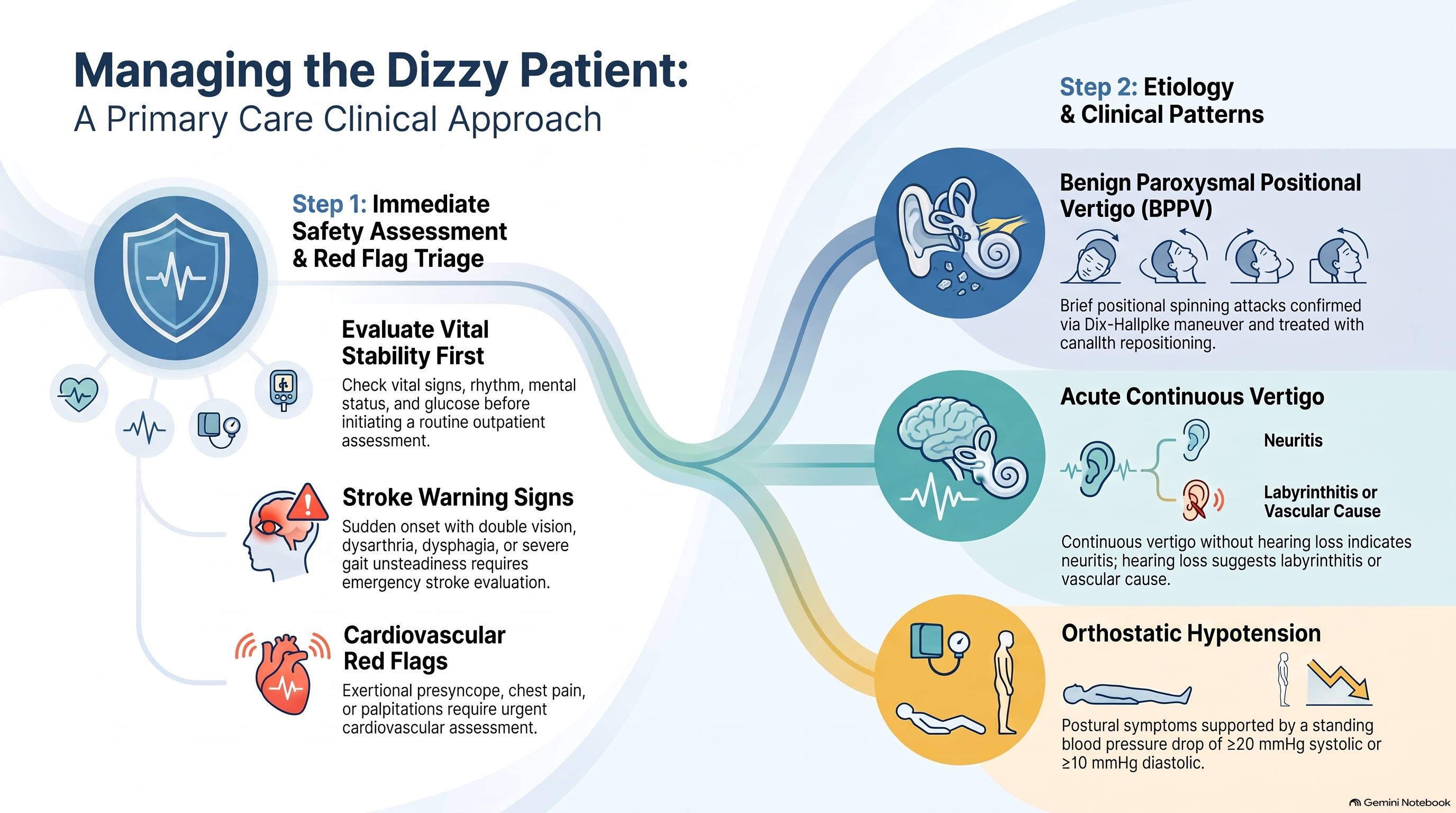
Observe the patient’s general condition. Check vital signs, pulse rhythm and mental status. Assess whether they can sit, stand and walk safely.
Check glucose when hypoglycaemia is possible, particularly in someone with diabetes.
Sudden dizziness with neurological findings or marked new unsteadiness requires urgent assessment for stroke.
Presyncope with chest pain, significant breathlessness, an abnormal rhythm or circulatory instability also needs emergency evaluation.
Do not begin a prolonged outpatient assessment when the presentation requires emergency care.
2. History
Clarify What Dizziness Means
Ask the patient to describe the sensation in their own words.
Is the room moving? Do they feel close to fainting? Are they unsteady when walking?
These descriptions help, but timing and triggers are often more useful than the label.
Establish Timing and Triggers
Ask when symptoms began, how long they last and whether the patient returns to normal between episodes.
Distinguish three broad patterns:
- Brief episodes triggered by a specific movement or standing.
- Episodes occurring spontaneously without a clear trigger.
- New continuous dizziness lasting hours or days.
An important distinction is whether movement triggers a new attack or merely worsens dizziness that is already present. Head movement can aggravate both peripheral and central vestibular disease.
Ask About Associated Symptoms
Explore hearing changes, tinnitus, ear fullness, nausea, vomiting and migraine symptoms.
Ask about double vision, speech difficulty, swallowing problems, weakness, numbness and severe headache or neck pain.
For possible presyncope, ask about palpitations, exertion, bleeding, dehydration and actual loss of consciousness.
Review vascular risk factors, cardiac disease, recent illness, medicines, alcohol and other substances.
3. Examination
Examine the Heart, Nervous System and Balance
Check the pulse and listen to the heart. Measure orthostatic blood pressure and heart rate when the history suggests postural symptoms.
Perform a focused neurological examination, including eye movements, cranial nerves, strength, sensation and coordination.
Assess gait when safe. Severe new difficulty standing or walking is particularly concerning.
Inspect the ears and assess hearing when symptoms suggest an auditory component.
Observe nystagmus, but do not interpret one eye finding in isolation.
Measuring Orthostatic Blood Pressure
Ideally, allow the patient to lie supine for five minutes, then measure blood pressure and heart rate. Repeat after standing, including at approximately one and three minutes.
A fall of at least 20 millimetres of mercury systolic or 10 diastolic within three minutes supports orthostatic hypotension.
Interpret the result alongside symptoms and medication use. A normal office measurement does not completely exclude an intermittent problem.
4. Red Flags
When to Suspect Stroke
Sudden dizziness with new double vision, dysarthria, dysphagia, weakness, sensory changes or severe gait disturbance requires emergency assessment.
Posterior circulation stroke may present without the familiar face, arm and speech findings. Absence of those findings does not establish safety.
New severe headache or neck pain, particularly after injury, also increases concern for a vascular cause.
Document onset or last-known-well time and activate the local stroke pathway when indicated.
Hearing Loss Does Not Prove an Ear Cause
Sudden hearing loss needs urgent assessment.
When it accompanies acute continuous vertigo, consider both inner ear disease and a vascular cause. Do not automatically label it labyrinthitis.
Cardiac Warning Signs
Presyncope or syncope during exertion, associated palpitations, an abnormal ECG, known structural heart disease or a family history of early sudden death warrants urgent cardiovascular assessment.
The urgency depends on the patient’s current condition and findings.
5. Bedside Tests
Dix–Hallpike for Suspected Positional Vertigo
Use the Dix–Hallpike manoeuvre when the history suggests brief positional attacks, provided the patient can safely tolerate it.
Characteristic torsional, upbeating nystagmus supports posterior canal BPPV.
Dizziness alone during the test is less specific. Atypical findings need further assessment.
If the history remains suggestive but the test is negative or produces horizontal nystagmus, consider a different canal and an appropriate supine roll test or referral.
HINTS Requires Training and the Right Patient
HINTS combines the head impulse test, assessment of nystagmus and a test of skew.
It is intended for an appropriate acute vestibular syndrome: new persistent dizziness or vertigo, with ongoing symptoms and nystagmus.
It should be used by clinicians trained in its performance and interpretation. It is not a general screening test for every dizzy patient, brief positional attacks or symptoms that have resolved.
If stroke remains possible and appropriate expertise is unavailable, arrange emergency assessment rather than attempting to reassure with an unreliable bedside test.
6. Investigations
Investigate the Suspected Cause
Typical BPPV with characteristic findings generally does not require routine brain imaging.
Obtain an ECG when presyncope, palpitations, syncope or a cardiac cause is suspected. Intermittent symptoms may require ambulatory monitoring.
Order blood tests selectively, guided by concerns such as anaemia, electrolyte disturbance or metabolic disease.
For suspected stroke, hospital assessment determines the imaging pathway. A normal non-contrast CT does not reliably exclude an acute posterior circulation infarct. Early MRI can also miss some strokes, so persistent clinical concern matters.
Arrange audiometry for relevant hearing symptoms.
7. Common Causes and Management
Benign Paroxysmal Positional Vertigo
BPPV usually causes brief spinning attacks with movements such as rolling in bed, looking upward or getting out of bed.
Treat confirmed posterior canal BPPV with a canalith repositioning manoeuvre, such as the Epley manoeuvre, or refer to someone who can perform it.
Routine vestibular suppressants do not correct the underlying problem and are not recommended as standard treatment.
Reassess persistent symptoms rather than repeatedly prescribing medication.
Vestibular Neuritis
Vestibular neuritis typically causes acute continuous vertigo, nausea and imbalance without new hearing loss.
The diagnosis requires assessment for central causes.
Once established, management includes hydration, brief symptom control when needed and gradual mobilisation. Prolonged vestibular suppressant use can delay compensation.
Vestibular rehabilitation helps recovery. Corticosteroids may be discussed early, but evidence of benefit is uncertain.
Labyrinthitis
Vertigo with hearing loss may reflect labyrinthitis, but sudden hearing loss requires urgent assessment rather than routine reassurance.
Treatment depends on the cause and findings.
Ménière’s Disease
Recurrent spontaneous vertigo with fluctuating hearing loss, tinnitus or ear fullness suggests Ménière’s disease.
Arrange audiometry and specialist assessment. Management is individualised and may include lifestyle measures, symptom treatment and specialist-directed therapies.
Vestibular Migraine
Vestibular migraine causes recurrent vestibular symptoms in someone with a migraine history or associated migraine features.
Headache may be absent during a dizzy episode.
Management includes regular sleep and meals, identifying relevant triggers and considering migraine prevention when episodes are frequent or disabling.
Do not use a migraine history to dismiss a new concerning presentation.
Orthostatic Hypotension
Symptoms occur after standing and may improve with sitting or lying down.
Review contributing medicines and reversible causes. Encourage gradual position changes and appropriate hydration. Additional salt or fluid advice must account for heart failure, kidney disease and other contraindications.
Persistent symptoms may require compression measures, specialist assessment or medication.
Medication Effects and Multifactorial Imbalance
Sedating medicines and drugs affecting blood pressure can contribute to dizziness and falls.
Review recent changes and cumulative effects. Adjust treatment carefully rather than stopping essential medicines indiscriminately.
In older adults, vision, neuropathy, musculoskeletal limitations and vestibular problems may contribute together.
8. Follow-Up and Safety Advice
Give the Patient a Clear Plan
Explain the working diagnosis, treatment and expected recovery.
Discuss fall prevention and avoiding driving, heights or machinery while symptoms make these activities unsafe.
Arrange review for persistent symptoms, treatment failure, recurrent falls or diagnostic uncertainty.
Give specific emergency advice for new weakness, speech or vision changes, inability to walk, severe headache, chest pain or collapse.
Closing
A useful dizziness consultation starts with safety, then timing and triggers.
Choose bedside tests for the correct presentation, investigate selectively and treat the identified cause. Reassess when the pattern changes or recovery does not follow expectations.
Listen to practical clinical episodes at TopMedCast.com, then strengthen your clinical reasoning with practice questions at TopQBank.com.
This is TopMedCast. Thank you for listening to The Dizzy Patient: A Practical Approach to Dizziness in Primary Care.
This content is for educational purposes only and does not constitute medical advice or clinical guidance. Read the full disclaimer.